Showing posts with label Latinos/as. Show all posts

Saturday, March 17, 2012

Guatemala, Guatebuena, Guatemaya 2

(Again, title stolen from a Edelberto Torres-Rivas article)

The night we returned from Chichicastenago J and I had a little talk about how much time we were spending travelling, how exhausting it was, and how neither of us was spending enough time relaxing by the lake. We made some preliminary plans to skip climbing the Volcano San Pedro the next day and committed instead to explore San Pedro and sit by the beach. Unfortunately after hitting the communal dinner and having a several carafe's of wine I took a bet from the twenty-something Canadian stoner across the table that J and I were going to climb San Pedro with him. My hubris at this moment, in spite of my agreement with my boyfriend, can partially be attributed to the alcohol which at times tends to bring out the braggart-y masculinist part of me that needs to prove things to others and always win arguments. 

Apparently this Quebecois youth had made contact with a lancha pilot at the dock who had offered to sell him marijuana and also take him, along with whoever else, up San Pedro for a fee (much like many of the tour companies offered on Lago Atitlan). We assented although the incredibly-prolix stoner kid did not speak any spanish so I had to handle the call to this informal tour guide, who on the phone seemed pretty stoned himself. At the time is seemed like a fun idea, but as the evening progressed another moment of panic set in for me and J as our minds quickly turned to Guatemala's dispersed and systematically violent history (paramilitaries, death squads, 200,000 dead et al.) and we began to freak out a little bit. Moreover, another friend from Portland a hilarious punk woman, W, had sent us a very cryptic e-mail just before canceling the rest of her trip in Guatemala on account of being sick closing with the words "My friend Jenna says don't climb San Pedro." Since our tour books were like 5 years old they told us to get tourist police escorts when climbing San Pedro because it was often a place where bandits preyed on tourists. The cryptic last line from W (what the fuck did they see to say that?) and the suggestion of banditry again sent me reeling for a bit. 

J with his indomitable will-power refused to believe any such thing after freaking out for a few minutes. I, on the other hand, spent the night wide wake trying to imagine every possible scenario and how I could extricate us with a little bit of fast-talking. The morning came and I hit the moment when I surpassed the fear. The guide showed up and I interrogated him on his credentials. I think our skepticism shook him a bit, but he handed us off twice to two other affiliated tour guides (apparently he was scheduled to pilot a lancha) the last of which was named Pancho or "'Cis" (short for Francisco), who ended up being the friendliest and most good humored tour guides I have ever encountered. He didn't speak any English but at this point J was feeling pretty confident about what he understood and had me ask questions, but was able to translate an impressive amount of Spanish. The altitude and thin oxygen managed to quiet the oppressively-loquacious Canadian to whom I had suggested, earlier in the day, that he inhabited the fortuitous life of someone out of a narcocorrido as his stories featured an universally recognition of him as a seasoned weed connoisseur and thus he was shown massive stashes of "gourmet" mota everywhere he went. 

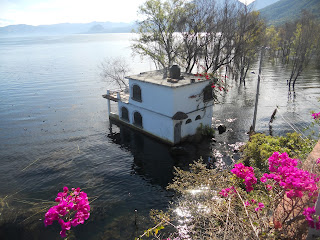
This left me and 'Cis to have long conversations about his Mayan heritage, the culture of Lago Atitlan, the poetry he enjoyed reading, and what he thought of the United States which were fascinating. The climb was beautiful and at the top (view seen above) we munched egg and roasted veggie sandwiches, basking in the sun, and semi-napping. No bandits to be found and in reality we didn't even need a guide as the trail was clearly marked and tourist police were posted a various points in the climb. 'Cis invited us back to his family's home in San Pedro where they treated us to hot chocolate that had been wrapped in orange leaves. His home very much reminded me of my childhood home in Mexico City with the corrugated aluminum roof and hand plastered concrete walls. 

We said farewell to the incessantly talkative Canadian heading off to our hotel in San Pedro, Mikaso. This was probably one of the more expensive hotels we stayed at (amounting to I believe 700 quetzales that night plus breakfast for 2 people), but at the same time seemed worth it precisely because we were exhausted by the climb and needed a good hard rest and a clean shower. After a shower we wandered around San Pedro getting a mediocre meal at some expat bar with the word "Buddha" somewhere in the name (clearly expats from  1990s America). After wandering San Pedro proper looking for a cash machine observing the market, the church, and the basket ball court (the 1954 occupation of Guatemala by the United States fostered this one cultural export) we returned to the shore area (colonized by ex-patriots from Norway, the United States, Germany, Britain, and of course, as with any space of natural beauty in Latin America, Spanish hippies) to have amazing drinks (blended pineapple with cardamon and rum, and some sort of green and fresh ginger + another alcohol) at this little possibly Canadian-expat and his Chapin (what Guatemalan's colloquially call themselves) boyfriend's restaurante called La Ventana Azul, a place I hands down recommend if you ever go to Lago Atitlan. 

Peaceful sleep and chill morning later J and I returned to Panajachel, the transit center of the lake, to catch a shuttle to Monterrico on the Pacific Coast. Here began the the trip's slump. I had insisted that we see the black, volcanic sand beaches of Guatemala, J wanted some beach time, and I thought it would be good to hit a space of Guatemala sans-tourists (it seems that often Mexicans and Central Americans spend time on the beach during the Christmas and New Years holiday). One onerous stupidity in my planning is for some reason I had thought that the travel to Monterrico would be an hour from Atitlan. This I discovered was not the case and shuttle took about 3 1/2 hours to get to the destination, on a fairly poor stretch of highway along the Pacific where the only traffic control mechanism were endless, unevenly built topes (speed bumps). We arrived to our expat owned hotel, this time a Norwegian man, with a much younger Guatemalan wife, and rushed to the beach for the last few hours of sun before the New Years' Eve festivities began. The beach and sunset to be sure were beautiful were it not for a mess of Middle Class Guatemalan's shit-talking us from afar, I wasn't clear on why. 

Rocky evening continued as we scoured the town for somewhere to eat, passing cholos in low riders, and families finally deciding on an expensive non-buffet-style buffet where we were not allowed to grab extra-beans despite not consuming any of the meats they offered. After a few drinks and the crawling experience of mosquitos chomping away at our bodies, coming off of the mangrove swamp the surround the beach, we parked ourselves closer to the ocean watching the stars come out. As midnight approached we retreated to a bar for a bucket of beers and watched the NYE pyrotechnics as it seemed every beach town on the Pacific Coast was lighting up their own vernacular fireworks display which was amazing in a way no orchestrated 4th of July fireworks show seems to achieve in the United States. This may have been the highlight of the visit to Monterrico. 

The next day we meandered around looking for a good beach spot and I realized the fundamental issue that emerges when you seek to avoid tourists altogether and you yourself are a tourist: people constantly give you looks the communicate "what the fuck are you doing here?" That coupled with the fact that J is rather muscular, large, Anglo in hair and eye color with a military style cut he probably looked like some Special Operations Forces trainer or at the very least a semi-imperialist gringo in look generated a significant amount of attention for J as we cruised around buying waters and snacks, something he found a little unnerving. We did find a nice relatively empty scrap of beach and watched Guatemalans sort of lay in the shallows like beached whales (culturally out hotel owner reminded us, it is not common for Guatemalan parents to teach their children to swim. One semi-irritating element that plagued us throughout the visit was the ladino families' enjoyment of endlessly driving all-terrain vehicles and dirt bikes up and down the beach. 

Later in the day after looking for another meal and releasing some baby sea turtles from a nearby sea turtle sanctuary (what Monterrico is famous for really) we settled back at the hotel, already we could tell that 1 day was just about enough to take in Monterrico, and laid around under the mosquito net on our bed looking through our photos, when J realized that he was having sort of reaction to the hotel food: shitting his brains out as well as vomiting. The hotel which surrounded a modest pool filled with screaming children, with loudspeakers blasting salsa, and neighbors in the adjoining room having very loud sex amounted to J's nightmare evening. I medicated J to get his fever down, asked the hotel owner to turn down the music, and we managed to get some sleep eagerly awaiting the shuttle that would take us off to Antigua for J's last day in Guatemala. After breakfast I promptly shat my pants and had to quickly shower so that we might make our shuttle on time and get out of Monterrico. I should say to tourists that Monterrico is much more of a place for families and not really one of the more important places to visit in Guatemala.

Antigua, a more standard tourist destination, was only a few hours away by shuttle and the cooler mountain air helped us shake off the unnerving elements of our visit to Monterrico. It is  colonial city, the former capital of Guatemala until earthquake wrecked significant components of the city's infrastructure, producing some really gorgeous ruins of former convents, monasteries, and a cathedral. In contrast to the humid, dub-step-drenched, bustle of Monterrico, Antigua Guatemala was a more peaceful hum of tourists, locals, and minor traffic on cobblestones. When compared to the life of the average Guatemalan Antigua appears to be a sort of middle class refuge in the mountains, which clearly has advantages of being fairly clean, I suppose it's safe (?), a few "apparent" 'mos walking around, but it also has the drawback of sheltering its residents (who are mostly ladino, i.e. mixed indigenous and Spanish/European) from the increasingly impoverished conditions of most of Guatemala that is at least 50% indigenous Maya (I've heard tell that the residents of Antigua work in Guatemala City and live in Antigua). We managed to see the most significant landmarks of Antigua on foot in about 8 hours, get some coffee, and have a really pleasant, altogether inauthentic, meal of paninis and Chilean wine in a garden restaurant that lost power halfway through our dinner. 


Early the next morning J had to shuttle it to the Guatemala City airport in order to return to work. I had the advantage of hanging out in Antigua that morning perusing the market there, having some excellent coffee (most Guatemalan coffee is harvested for export, not much roasting goes on in the country) and finishing Asturias' El Señor Presidente. My friend, B, had e-mailed me earlier that she would return to Guatemala city early that day and I should meet her at her home in Zone 2. I caught another camioneta back to Guatemala city and then a cab through to B's apartment. B's apartment was a typical Latin American construction with a great deal of internal windows to seal off or to better circulate air. I was still feeling physically ill so we didn't do anything particularly challenging: we checked out the anthropological museum I had missed my first time around, ate vegetable lo mein and fried rice at one of Guatemala city's numerous Chinese restaurants, hit a Guatemalan thrift store (where all the thrift store clothes that don't sell in the United States go), bought a few books in Spanish on the subject of my dissertation, chatted a great deal, and watched the entire first season of Game of Thrones. Along our walks I got to check out the graffiti and public postering projects of HIJOS Guatemala a public memory project to address the coerced amnesia about the civil war, the disappearances that remain unsolved, and to some degree to maintain the legacy of militancy and revolutionary spirit of the demilitarized, destroyed guerrilla organizations. Here is one example that is upside down because I can't figure out how to rotate images on this blog (translates roughly as "Military Service, Cerebral/Mental Death"):


It was actually very cool to hang out in the city with B, it remapped the space for me and B's ease of moving throughout the central zones (no longer sexually harassed because she was with a man) made it a pleasure even if my guts did not agree. Visiting Guatemala was an amazing way to get a better sense of the cultural texture of some of the region even if I spend a significant amount of time in tourist destinations. At the very least my Spanish was very good toward the end. I think another trip is in order in the future to get a better handle on peoples, politics, and the organization of the society now that another military leader is in power.

Wednesday, February 29, 2012

Guatemala, Guatebuena, Guatemaya 1

(Title stolen from an article by Edelberto Torres-Rivas you can find here.)


I've been meaning to post some details of my 10 day trip to Guatemala here, but the increasing stress from dissertation elements and long distance relationship, coupled with a sense that blogs are decreasingly useful mediums for communicating has delayed me significantly. 


Guatemala is a beautiful country with a systematically violent but also profoundly, richly political history. It is, by way of military, solidarity, and refugee discourses, a place think about somewhat in my dissertation. The motivations for going were therefore mixed. My boyfriend gets paid vacation time every year and he wanted a jaunt somewhere to help me at least "inhabit" the subject of my dissertation somewhat, even if that means I would be there having drinks and chilling by a giant, beautiful lake while reading about genocide. My friend B is also in Guatemala City (the capital) doing fieldwork for her anthropology PhD, so we had a potential person with who we could visit.


Because my bf doesn't have any free time in his job that demands he work 12 hour days, I did much of the planning on my own, consulting travel guides, friends, and also various internet review sites. Roughly sketched out the trip involved flying into Guatemala City, heading immediately out to Tikal, coming back to Guatemala City and shooting West toward Lago Atitlan for several days, hitting the Pacific Coast by way of Monterrico, spending a day and night in Antigua, back to Guate to see B. All compacted unrealistically into very little time.


Arrival in Guatemala City:


Pittsburgh is freezing during the Winter and it is also bleak, so banking off of clouds to see an overwhelmingly green landscape and warmth was a rather welcome sight. I had basically left us six hours to check out Anthropological Museums and eat in Guatemala City before catching a late night bus (on Linea Dorada) to Tikal. My plan was to get to a museum, stash our bags at the coat check, immerse ourselves in the anthropological material of the museum and then plan our next move, to hit a coffee or dinner, check el centro. We arrived the day after Christmas and I hadn't realized that the museums would be closed for a week for the holiday. We asked our cab driver to take us to another museum, which was also closed. Since we were near the center of town anyway we had him drop us off there so we could at least wander around and get some coffee or street food. I was at this point a little overtaken by panic, I foolishly internalize things like Guatemala's 200,000 genocide and the torture of thousands more as some sign that we too would be targeted and murdered, as obvious tourists. As irrational as I knew these feelings were, I couldn't quite keep my fear under control for the first hour or so in the city. 


We managed to find a decent coffee shop and we wandered around the plaza which was lovely, strung with lights, vendors selling elotes, etc., a cathedral with a few minor nondescript monuments to the genocide, and well kept flowers. Avenida 6a running down from the center of the plaza has been closed off to automobile traffic producing a very pleasant pedestrian avenue where we familiarized ourselves with the various iterations of the faux hawk popular amongst the nations young men. We managed to find a vegetarian restaurant at the end of the avenue where we munched on odd, but not altogether bad veggie variations of guatemalan traditional foods like tamales (in this nation wrapped in banana leaves rather than corn husks, as in Mexico). We split some overpriced beers and caught our overnight bus. (Incidentally Guatemalan beers aren't very good, as with other Latin American nations lagers are the preferred form, but the Gallos and Mozas were not particularly tasty.)


The bus was packed and the bus ticketing agent giggled at my gigantic internet print out tickets. Linea Dorada operates what seems comparable to Greyhound buses in the United States with semi-reclining seats and powerful aire acondicionado. I managed to not sleep very well and the bf snuck our arms around each other beneath our blanket (note to the homos: Guatemala is not a tolerant nation for homosexual peoples, it's best to travel on the DL if you can, although it is much more common for heterosexual men to touch other men and put their arms around friends or loved ones in public more than in the United States).


Tikal:


In order to visit Tikal National Park, an archeological treasure of an ancient Mayan city sitting at the edge of the jungle, you first fly or bus into Flores, a small island town where you either obtain a bus to the site or enjoin a tour company to get you to the site and guide you through was is a very confusing set of paths where tourists lose their way annually. After working on some miscommunication with our tour company we managed to get a bus over to the site, and checked around for guides who spoke English, so that my boyfriend (J from here on out) could also understand the tour. The tour lasted three hours and the site was beautiful, massive and impressive temples rising out of the jungle, ancient Maya stelae, and the odor of copal (a pine sap incense) which seemed to permeate much of Guatemala or at least infected my senses for the duration of the trip.


For the remaining evening hours in Flores, J and I snuck into an alley to throw on swim trunks and we hit the lake surrounding Flores during at sunset. The lake is pleasantly cool, but warm enough that one could spend some time there. Our dinner was fine, a little overpriced and not as good as breakfast. My favorite meal in Guatemala tended to be breakfast tipico, which consists of two eggs, black beans, toast, chirmol (a non-spicy tomato onion sauce), and fried plantains. This breakfast is to be found everywhere in Guatemala for cheap in even the smallest comedores


Toward Lago Atitlan:


We caught another overnight bus back to Guatemala City that night, arriving a half hour shy of 6am. Our guidebooks were fairly old, 2007 I believe was the most recent one we had between us, and we had plans to catch a camioneta to Panajachel, a city along Lago Atitlan, that morning from a particular site in Zone 1 Guatemala City. Our cab driver suggested that our books were wrong and the camionetas (or "chicken buses" as they are called by Anglos) picked up somewhere in Zone 8. Again I was confronted with a moment of First World panic (or maybe Mexican?--kidnapping is a national industry there) as I imagined another scenario in which we would again be robbed and murdered. We arrived and were told we need to catch a bus to a midpoint in Encuentros where we could catch a bus to Solola and onto Panajachel. Taking camionetas I think is a definitive experience for anyone visiting the country for the first time. These are former American school buses that are tricked out with bright colors, chrome plating, and have sound systems blasting reggeaton. Our driver looked like he was 19, his assistant 14, as they throttled up mountains at 90 mphs. 


As we travelled through the rainy landscape we were treated to another Guatemala's surprising features: a wandering evangelical Protestant Preacher. For the course of an hour we were force fed a stream-of-consciousness sermon about finding Jesus amidst family tragedy and several songs. One feature of the counterinsurgency wars in Central America has been the increasing presence and power of evangelical Christianity both as a corrective to Vatican 2s enabling of liberation theology (a significant element of revolutions in Guatemala and El Salvador) and to defuse political energies elsewhere than resistance to the mandates of the landed oligarchy and the army. After switching buses twice at a fairly efficient rate (both buses were waiting to pick up passengers and almost immediately left after we boarded) we arrived at a sunbaked Panajachel. After getting our bearings, consuming coffee and breakfast, we loaded onto a lancha headed for a hotel I had arranged for us in the small village of Jaibalito. Lanchas are the cheapest way to get around the lake towns as the lake is surrounded by forested volcanos. Typically you load onto a lancha with 15-20 other passangers making stops at villages and towns along the way. Atitlan has to be one of the most beautiful natural locations I have ever been so riding in the lancha was a rather amazing way to see the bright blue of the lake and the life surrounding the water.


Set in a beautifully manicured garden the hotel (called Vulcano Lodge) was a set of bungalows a bit off from the lake, and as soon as we arrived was the first time we had significant time to relax since the trip began. J and I snuck over to a neighboring hotel's patio/dock and spent the afternoon basking the beautiful surroundings, swimming, and reading, my recommended book of the trip El Presidente by Guatemalan novelist Miguel Angel-Asturias (which depicts the abjection and experience of living in the surveillance culture of a military dictatorship). As relaxing and restorative as the time at the lake was the way our hotel was set amidst a rather impoverished looking village with little in terms of public plumbing and not apparent school or medical services within reach (perhaps there is a hospital nearby)? It was a good reminder of the deeply inequitable and exploitative economic situation upon which the tourist economy sits in Guatemala (and also the degree to which the United States has been responsible for destroying its conduits for unrest about the inequality, as in overthrowing the first president to enforce a land reform). 


The hotel offered a family-style meal with other residents and seeing no other options for eating dinner we joined what appeared to be several incredibly boring MidWestern American and their Canadian equivalents for dinner. The food was relatively good, even for two vegetarians, and with the dull families we agreed to share a shuttle the next day to visit Chichicastenago, a mountain town famous for it's large markets vending "indigenous" textiles, pottery, and other goods as well as for a still very active syncretic Maya-Catholic culture. We arrived relatively early to Chichicastenago so the longer we paced the streets, the more narrow they became as vendors divided the streets with proliferating stalls. Many of the textiles, for which Guatemala is famous, were clearly made in factory contexts and not really the handicrafts one might expect, which is not surprising but it didn't stop the vendors from haggling with you complaining about the lack of value "mi trabajo" was receiving. We bought a few really nice pieces, but as the streets became more claustrophobic the process of haggling made me incredibly anxious; anxious because of an awareness of my position as someone coming from the core of the world economy and all the privileges it affords me arguing for a better price against someone with less prospects, in all probability a shorter lifespan, in a language I failed to maintain because it was easier to learn English than to try and maintain any semblance of my culture in the overwhelmingly homogenous MidWest of the US. More tension emerged later, J had suggested we try and find some decent street food which seemed in short supply in the streets we were exploring. On finding on stall we purchased some small tortillas and warm black beans, seeing not much else for vegetarians to consume. A potentially homeless man shoved himself next to us asking for money and a few tortillas, which spurred a fight between me and J over why I let said dude paw the food we had only just begun to eat. After a fight and a long session of lesbian-style processing we decided that despite the very cool tapestry we bought and getting a chance to see the interior of its Maya-Catholic church (reeking of copal incense) Chichi should have been a 3 hour trip, not one lasting the whole of a day.

Sunday, November 6, 2011

Poverty Statistics Hitting News Outlets, 1 in 15 Americans Affected by Poverty

From The Skanner:


They demonstrate the shifting compositions of urban poverty in the United States, with a recognition of undocumented and increasing Latino poverty:

"The new supplemental poverty measure for the first time will take into account non-cash aid such as tax credits and food stamps, but also additional everyday costs such as commuting and medical care. Official poverty figures released in September only take into account income before tax deductions.Based on newly released estimates for 2009, the new measure will show a significant jump in overall poverty. Poverty for Americans 65 and older is on track to nearly double after factoring in rising out-of-pocket medical expenses, from 9 percent to over 15 percent. Poverty increases are also anticipated for the working-age population because of commuting and child-care costs, while child poverty will dip partly due to the positive effect of food stamps.For the first time, the share of Hispanics living in poverty is expected to surpass that of African-Americans based on the new measure, reflecting in part the lower participation of immigrants and non-English speakers in government aid programs such as housing and food stamps. The 2009 census estimates show 27.6 percent of all Hispanics living in poverty, compared with 23.4 percent for blacks."


Monday, October 31, 2011

Thoughts on Punk and Race, from the Editors of White Riot

In an interview with souciant.com:


Sunday, October 2, 2011

"Just Gathering Statistics," Alabama's Kristallnacht for the Undocumented

I grabbed this story from Tex(t)Mex blog,which points to a similar logic behind the recent changes to Alabama's racist new citizenship laws. The response by many undocumented families in the region was to flee:


Mass deportation is not a new story when it comes to undocumented laborers in the United States. It is a standard means of producing labor control even if the move is garnered by grossly nativist sentiments (see "Operation Wetback" for example). At the same time, their rate is accelerating and expanding, additionally seeding a set of subcontracted companies of incarceration and control that are exorbitantly profitable.

Thursday, September 15, 2011

Friday, August 5, 2011

Tracks that Occupy the Space of Dread Leading Up to Prospectus Draft Submission

The first is a track by Chavela Vargas, a lesbian caught up in the heady days of México's revolutionaries and vanguards. Reconfiguring the traditional, torch-song ranchera songs, with some queer flavor. For a brief period she had an affair with Frida Kahlo.


Chavela vargas - la llorona by laodameia


Death Grips. I tend to think that more often than not rock/punk/hip hop intersections don't always work out for the best. I think a good example of this might be Mad Decent World's podcast that set punk and hardcore anthems in a kind of hip hop ambience as podcast/mixtape which doesn't completely fit with the irruptive qualities of punk/hardcore, at least in places. This does an interesting merger by not always trying to balance elements to give each their due, but rather in cases merely channeling a punk angry affect, in other cases chanting more than rapping to reduce the dissonance between the two elements. Download this full album free at the Death Grips website.


Stay+ (formerly Christian AIDS, but had to change the name after a cease and desist order from Christian Aid the NGO). This track is double reminiscent of both 1980s era New Order-like melancholy, '90s dance pop, but is also an indirect tribute to the intensely driven, urgent, and anti-establishment activism of ACT-UP in the 1990s (an organization I have a lot of respect for) in response to the accelerating AIDS crisis to which the Reagan administration turned a blind eye (in the end killing thousands just in New York City). Download some of their material here.


In my endless pursuit of musical material that appeals to my punk/metal interests that nonetheless is something I can read, write, or study to, I recently stumbled upon this beautiful video by Kerretta.


Sunglitters have incredibly chill tracks perfect for a panic-stricken summer:


Also, Cayos, supply me with some tracks to lower the blood pressure:


IceAge, some atypical Danish teens, producing a post-punk fuzz ridden track that instills occasional desire to start dancing


Iceage - New Brigade from iceage on Vimeo.

Tuesday, July 26, 2011

The Koch Empire and Venezuela

You may remember the Koch brothers from the recent outbreak of popular outrage over the liquidation of public employee bargaining rights by the current governor of Wisconsin, Scott Walker. The Koch brothers spent over $34 million dollars trying to undermine workers rights particularly of public employees seemingly in collusion with Walker. What you might not know about them is that last October they saw the fertilizer plants they owned in Venezuela nationalized by standing President Hugo Chavez.

You might think this would be a story ripe for Fox News or various rightwing pundits to pounce upon. Here's why they kept the nationalization hush hush, from eXiled:

"The Kochs made hundreds of millions on every end of this deal…and even more surprising, bond markets cheered the nationalization. In other words, the free markets championed by the Kochs gave a big thumbs-down to Kochs’ negative influence on the value of the business, while at the same time, the free-market Kochs earned huge windfalls doing business with socialists. No wonder this story hasn’t made the rounds.

Here’s what happened: When Chavez’s nationalization of the plant took Koch Industries out of the picture, bond investors responded by driving up the value of the company’s bond debt by a whopping 33 percent. That means they had a lot more confidence that the debts would be paid back AFTER the free-market Kochs were out of the picture. As every business school flunky knows, price fluctuations of bonds are very much like those of stocks: the more they cost, the higher the confidence in a given company. And that means investors had less faith in the ability of the Kochs to run a tight business operation than they did in a bunch of Venezuelan socialist bureaucrats.

[...]

So for all the enterprising Americans out there wondering “What’s the secret to the Kochs’ success?” The answer isn’t pretty—especially if you’re one of the gullible Tea Party libertarians who believe the Kochs practice the free-market libertarianism that they preach. Their ability to reap billions and billions in profits year after year isn’t about buying low and selling high, but about buying subsidized-by-the-state, and selling subsidized-by-the-state. Using taxpayer money to cover the costs and ensure profits every time—that’s the simple formula to the Kochs’ success."


What's more is now the Koch's appear to be taking Chavez's government to court over the nationalization, before a investment dispute body in the World Bank. Check out this article from the Latin American Herald Tribune for more.

Tepoztlán and Movements for Autonomy in México


A Narconews report on a community's response to "a building project that would’ve turned communal lands into a golf course. When the people of Tepoztlán found out about the plan, they expulsed the mayor and the police and barricaded all entrances to the town. During the eight months that followed, Tepoztlán organized its own community police and elected an autonomous government, free of political parties.

[...]

After eight months of autonomy, in April 1996, the police killed a local campesino, Marcos Olmedo, near the spot where Emiliano Zapata was shot exactly 76 years earlier. The man’s death was followed by the cancellation of the construction plan. The townspeople, exhausted and mourning but also pleased with their victory, gradually allowed the police and political parties to return to Tepoztlán.

Tepoztlán’s struggle is not the only of its kind. The eviction of the golf course marked a renaissance of resistance movements in the state of Morelos. During the almost 17 years that have passed since Tepoztlán first declared itself a free town, autonomous municipalities have popped up in different parts of the state. They have an impressive track record of winning most of their battles, but those victories have often been, like the one in Tepoztlán, tinged with sadness: many of the movements have failed to bridge the gaping class divisions that characterize Mexican society. Many times autonomy has lasted only a fleeting moment."

Thursday, July 7, 2011

Mark Krikorian is a Racist, Anti-Immigrant Immigrant

A commentator for the rightwing organization the Center for Immigration Studies (note the fact that it seeks to give the academy access to correct information on immigration as if the academy's own biases make this impossible) and Armenian immigrant, Mark Krikorian makes a fairly telling comparison (on National Public Radio) between how worthwhile immigrants are to the United States and some sort of national doughnut orgy:

Krikorian says we can think of immigration like a good fat-filled doughnut.

"When you're 11 years old, you eat all of the doughnuts that your parent will let you eat, and they're probably good for you at that point," he says. "When you're 50 years old, you can't eat doughnuts like that anymore. There's nothing wrong with the doughnuts. They're the same doughnuts. But your metabolism has changed. And our body politic's metabolism has changed so that we need to start now looking at what's good for our grandchildren, not what was good for our grandparents."


This comment with its veiled allusions to immigrants as sugary foods that not only pollute the bodies of elder members of a society, but also poison generations to come evinces ideas of racial/cultural purity, albiet ones impacted by a crude behaviorism. As much as this comment seems downplay its racism by reverting to a metaphor of unthreatening food, it still reeks of miscegnation panic of previous decades and centuries.

If you needed a little more convincing Krikorian's "post"racism observe his enlightening comments on Haiti following the earthquake:

"My guess is that Haiti’s so screwed up because it wasn’t colonized long enough…But, unlike Jamaicans and Bajans and Guadeloupeans, et al., after experiencing the worst of tropical colonial slavery, the Haitians didn’t stick around long enough to benefit from it. (Haiti became independent in 1804.). And by benefit I mean develop a local culture significantly shaped by the more-advanced civilization of the colonizers."

Commentators from Think Progress follow this comment up nicely with:

"In fact, Haiti’s comparatively short-lived colonial history might be the best thing the island had going for it. Haiti’s revolution inspired the fights for independence across Latin America and ushered in the end of slavery in the New World. Meanwhile, a never-ending sphere of Western influence and self-serving intervention probably offers a better explanation for why Haiti is as “screwed-up” as it is. Unlike the islands of Jamaica, Barbados, and Guadalupe, Haiti has long been the 'poster case for the vicious circle of colonial and foreign intervention, poverty, violence and political instability.'"

Wednesday, June 15, 2011

Al Jazeera's Fault Lines on Ciudad Juarez


Documenting the extreme disparity in exposure to violence between El Paso, Texas with the lowest crime rate in the U.S. and Ciudad Juarez, now the murder capital of the world.

Monday, May 16, 2011

Private Prison Corps. Benefitting from Crackdowns

illegal immigrant Pictures, Images and Photos

Some more specifics on the Corrections Corporation of America referred to in an NPR exposé of the lobbyists behind Arizona Senate Bill 1070,

From MSNBC:

"[Corrections Corporation of America] says its facilities perform as well as or better than regular ICE facilities or state prisons: "We view ourselves as part of the system, and a complement to what our government partners do. Both our government partners and our industries have evolved over the last 30 years and don't view it through that frame. We are trying to partner with them and be a complement to the existing system." And it vehemently denies that its business harms the public good — indeed, it claims to trim budgets and provide a more flexible alternative to the public prison industry. Still, many of the industry's critics regard its work as repugnant under any circumstance, because of the perverse incentive of CCA and others to increase the volume of people behind bars, with an emphasis on people ill-suited to advocating for their release. CCA's business model is similar to that of the hotel industry, in that profits come from filling beds with paying customers. And just as the Bellagio markets hard to persuade travel agents to bring their customers to Las Vegas, CCA lobbies hard to get state corrections departments to send their clients to Club CCA.

Its lobbying arm spends on average $1 million to $2 million annually — a minuscule amount, CCA says, compared with the lobbying efforts of comparably sized companies and other organizations, such as public employee unions. In fact, the amount is slightly above average for corporations of its size, as judged by publicly available lobbying records maintained by the website OpenSecrets. CCA's opponents, however, say they are more concerned about the effect of the lobbying than the number of dollars spent. They claim the lobbying has resulted in harsher laws, and thus more demand for CCA bed space."

Tuesday, May 3, 2011

A Note For Those Who Advocate "English-Only" Policies

While putting together an encyclopedia entry on Latino struggle, I came across an observation from Rumbaut & Portes from their Ethnicities: Children of Immigrants in America anthology:

"Forceful assimilationism does not seek to expel newcomers but to integrate them as quickly as possible into the American mainstrean. English immersion and the rapid loss of languages and cultures promoted by assimilationist policies weaken immigrant parents' authority and help drive a wedge between generations [...] The paradox, is that, in seeking to make 'good Americans' out of the second generation, English immersion and similar programs undermine the single resource poor immigrant youths have to succeed: namely, the social capital inherent in their families and co-ethnic communities. In the programmatic scenario promoted by forceful assimilationism, schools and immigrant families work at cross-purposes, with negative consequences for both" (315).

This suggests the fundamentally maliciousness of English only policy that seeks to actually eliminate the possibility of upward mobility for immigrant communities and instead producing what the authors describe as a "rainbow underclass."