Interesting piece by Nebojsa Seric Shoba commenting on the startling presence of the United States in geopolitics, and its capacity to illuminate in contrast to the dark world over which it can illuminate, from which it derives the resources to illuminate:
Showing posts with label Warfare. Show all posts
Showing posts with label Warfare. Show all posts
Thursday, May 10, 2012

Saturday, March 17, 2012
Guatemala, Guatebuena, Guatemaya 2
(Again, title stolen from a Edelberto Torres-Rivas article)

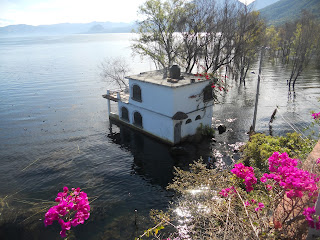


The night we returned from Chichicastenago J and I had a little talk about how much time we were spending travelling, how exhausting it was, and how neither of us was spending enough time relaxing by the lake. We made some preliminary plans to skip climbing the Volcano San Pedro the next day and committed instead to explore San Pedro and sit by the beach. Unfortunately after hitting the communal dinner and having a several carafe's of wine I took a bet from the twenty-something Canadian stoner across the table that J and I were going to climb San Pedro with him. My hubris at this moment, in spite of my agreement with my boyfriend, can partially be attributed to the alcohol which at times tends to bring out the braggart-y masculinist part of me that needs to prove things to others and always win arguments.
Apparently this Quebecois youth had made contact with a lancha pilot at the dock who had offered to sell him marijuana and also take him, along with whoever else, up San Pedro for a fee (much like many of the tour companies offered on Lago Atitlan). We assented although the incredibly-prolix stoner kid did not speak any spanish so I had to handle the call to this informal tour guide, who on the phone seemed pretty stoned himself. At the time is seemed like a fun idea, but as the evening progressed another moment of panic set in for me and J as our minds quickly turned to Guatemala's dispersed and systematically violent history (paramilitaries, death squads, 200,000 dead et al.) and we began to freak out a little bit. Moreover, another friend from Portland a hilarious punk woman, W, had sent us a very cryptic e-mail just before canceling the rest of her trip in Guatemala on account of being sick closing with the words "My friend Jenna says don't climb San Pedro." Since our tour books were like 5 years old they told us to get tourist police escorts when climbing San Pedro because it was often a place where bandits preyed on tourists. The cryptic last line from W (what the fuck did they see to say that?) and the suggestion of banditry again sent me reeling for a bit.

J with his indomitable will-power refused to believe any such thing after freaking out for a few minutes. I, on the other hand, spent the night wide wake trying to imagine every possible scenario and how I could extricate us with a little bit of fast-talking. The morning came and I hit the moment when I surpassed the fear. The guide showed up and I interrogated him on his credentials. I think our skepticism shook him a bit, but he handed us off twice to two other affiliated tour guides (apparently he was scheduled to pilot a lancha) the last of which was named Pancho or "'Cis" (short for Francisco), who ended up being the friendliest and most good humored tour guides I have ever encountered. He didn't speak any English but at this point J was feeling pretty confident about what he understood and had me ask questions, but was able to translate an impressive amount of Spanish. The altitude and thin oxygen managed to quiet the oppressively-loquacious Canadian to whom I had suggested, earlier in the day, that he inhabited the fortuitous life of someone out of a narcocorrido as his stories featured an universally recognition of him as a seasoned weed connoisseur and thus he was shown massive stashes of "gourmet" mota everywhere he went.
This left me and 'Cis to have long conversations about his Mayan heritage, the culture of Lago Atitlan, the poetry he enjoyed reading, and what he thought of the United States which were fascinating. The climb was beautiful and at the top (view seen above) we munched egg and roasted veggie sandwiches, basking in the sun, and semi-napping. No bandits to be found and in reality we didn't even need a guide as the trail was clearly marked and tourist police were posted a various points in the climb. 'Cis invited us back to his family's home in San Pedro where they treated us to hot chocolate that had been wrapped in orange leaves. His home very much reminded me of my childhood home in Mexico City with the corrugated aluminum roof and hand plastered concrete walls.

We said farewell to the incessantly talkative Canadian heading off to our hotel in San Pedro, Mikaso. This was probably one of the more expensive hotels we stayed at (amounting to I believe 700 quetzales that night plus breakfast for 2 people), but at the same time seemed worth it precisely because we were exhausted by the climb and needed a good hard rest and a clean shower. After a shower we wandered around San Pedro getting a mediocre meal at some expat bar with the word "Buddha" somewhere in the name (clearly expats from 1990s America). After wandering San Pedro proper looking for a cash machine observing the market, the church, and the basket ball court (the 1954 occupation of Guatemala by the United States fostered this one cultural export) we returned to the shore area (colonized by ex-patriots from Norway, the United States, Germany, Britain, and of course, as with any space of natural beauty in Latin America, Spanish hippies) to have amazing drinks (blended pineapple with cardamon and rum, and some sort of green and fresh ginger + another alcohol) at this little possibly Canadian-expat and his Chapin (what Guatemalan's colloquially call themselves) boyfriend's restaurante called La Ventana Azul, a place I hands down recommend if you ever go to Lago Atitlan.
Peaceful sleep and chill morning later J and I returned to Panajachel, the transit center of the lake, to catch a shuttle to Monterrico on the Pacific Coast. Here began the the trip's slump. I had insisted that we see the black, volcanic sand beaches of Guatemala, J wanted some beach time, and I thought it would be good to hit a space of Guatemala sans-tourists (it seems that often Mexicans and Central Americans spend time on the beach during the Christmas and New Years holiday). One onerous stupidity in my planning is for some reason I had thought that the travel to Monterrico would be an hour from Atitlan. This I discovered was not the case and shuttle took about 3 1/2 hours to get to the destination, on a fairly poor stretch of highway along the Pacific where the only traffic control mechanism were endless, unevenly built topes (speed bumps). We arrived to our expat owned hotel, this time a Norwegian man, with a much younger Guatemalan wife, and rushed to the beach for the last few hours of sun before the New Years' Eve festivities began. The beach and sunset to be sure were beautiful were it not for a mess of Middle Class Guatemalan's shit-talking us from afar, I wasn't clear on why.

Rocky evening continued as we scoured the town for somewhere to eat, passing cholos in low riders, and families finally deciding on an expensive non-buffet-style buffet where we were not allowed to grab extra-beans despite not consuming any of the meats they offered. After a few drinks and the crawling experience of mosquitos chomping away at our bodies, coming off of the mangrove swamp the surround the beach, we parked ourselves closer to the ocean watching the stars come out. As midnight approached we retreated to a bar for a bucket of beers and watched the NYE pyrotechnics as it seemed every beach town on the Pacific Coast was lighting up their own vernacular fireworks display which was amazing in a way no orchestrated 4th of July fireworks show seems to achieve in the United States. This may have been the highlight of the visit to Monterrico.
The next day we meandered around looking for a good beach spot and I realized the fundamental issue that emerges when you seek to avoid tourists altogether and you yourself are a tourist: people constantly give you looks the communicate "what the fuck are you doing here?" That coupled with the fact that J is rather muscular, large, Anglo in hair and eye color with a military style cut he probably looked like some Special Operations Forces trainer or at the very least a semi-imperialist gringo in look generated a significant amount of attention for J as we cruised around buying waters and snacks, something he found a little unnerving. We did find a nice relatively empty scrap of beach and watched Guatemalans sort of lay in the shallows like beached whales (culturally out hotel owner reminded us, it is not common for Guatemalan parents to teach their children to swim. One semi-irritating element that plagued us throughout the visit was the ladino families' enjoyment of endlessly driving all-terrain vehicles and dirt bikes up and down the beach.
Later in the day after looking for another meal and releasing some baby sea turtles from a nearby sea turtle sanctuary (what Monterrico is famous for really) we settled back at the hotel, already we could tell that 1 day was just about enough to take in Monterrico, and laid around under the mosquito net on our bed looking through our photos, when J realized that he was having sort of reaction to the hotel food: shitting his brains out as well as vomiting. The hotel which surrounded a modest pool filled with screaming children, with loudspeakers blasting salsa, and neighbors in the adjoining room having very loud sex amounted to J's nightmare evening. I medicated J to get his fever down, asked the hotel owner to turn down the music, and we managed to get some sleep eagerly awaiting the shuttle that would take us off to Antigua for J's last day in Guatemala. After breakfast I promptly shat my pants and had to quickly shower so that we might make our shuttle on time and get out of Monterrico. I should say to tourists that Monterrico is much more of a place for families and not really one of the more important places to visit in Guatemala.


Antigua, a more standard tourist destination, was only a few hours away by shuttle and the cooler mountain air helped us shake off the unnerving elements of our visit to Monterrico. It is colonial city, the former capital of Guatemala until earthquake wrecked significant components of the city's infrastructure, producing some really gorgeous ruins of former convents, monasteries, and a cathedral. In contrast to the humid, dub-step-drenched, bustle of Monterrico, Antigua Guatemala was a more peaceful hum of tourists, locals, and minor traffic on cobblestones. When compared to the life of the average Guatemalan Antigua appears to be a sort of middle class refuge in the mountains, which clearly has advantages of being fairly clean, I suppose it's safe (?), a few "apparent" 'mos walking around, but it also has the drawback of sheltering its residents (who are mostly ladino, i.e. mixed indigenous and Spanish/European) from the increasingly impoverished conditions of most of Guatemala that is at least 50% indigenous Maya (I've heard tell that the residents of Antigua work in Guatemala City and live in Antigua). We managed to see the most significant landmarks of Antigua on foot in about 8 hours, get some coffee, and have a really pleasant, altogether inauthentic, meal of paninis and Chilean wine in a garden restaurant that lost power halfway through our dinner.
Early the next morning J had to shuttle it to the Guatemala City airport in order to return to work. I had the advantage of hanging out in Antigua that morning perusing the market there, having some excellent coffee (most Guatemalan coffee is harvested for export, not much roasting goes on in the country) and finishing Asturias' El Señor Presidente. My friend, B, had e-mailed me earlier that she would return to Guatemala city early that day and I should meet her at her home in Zone 2. I caught another camioneta back to Guatemala city and then a cab through to B's apartment. B's apartment was a typical Latin American construction with a great deal of internal windows to seal off or to better circulate air. I was still feeling physically ill so we didn't do anything particularly challenging: we checked out the anthropological museum I had missed my first time around, ate vegetable lo mein and fried rice at one of Guatemala city's numerous Chinese restaurants, hit a Guatemalan thrift store (where all the thrift store clothes that don't sell in the United States go), bought a few books in Spanish on the subject of my dissertation, chatted a great deal, and watched the entire first season of Game of Thrones. Along our walks I got to check out the graffiti and public postering projects of HIJOS Guatemala a public memory project to address the coerced amnesia about the civil war, the disappearances that remain unsolved, and to some degree to maintain the legacy of militancy and revolutionary spirit of the demilitarized, destroyed guerrilla organizations. Here is one example that is upside down because I can't figure out how to rotate images on this blog (translates roughly as "Military Service, Cerebral/Mental Death"):

It was actually very cool to hang out in the city with B, it remapped the space for me and B's ease of moving throughout the central zones (no longer sexually harassed because she was with a man) made it a pleasure even if my guts did not agree. Visiting Guatemala was an amazing way to get a better sense of the cultural texture of some of the region even if I spend a significant amount of time in tourist destinations. At the very least my Spanish was very good toward the end. I think another trip is in order in the future to get a better handle on peoples, politics, and the organization of the society now that another military leader is in power.
Early the next morning J had to shuttle it to the Guatemala City airport in order to return to work. I had the advantage of hanging out in Antigua that morning perusing the market there, having some excellent coffee (most Guatemalan coffee is harvested for export, not much roasting goes on in the country) and finishing Asturias' El Señor Presidente. My friend, B, had e-mailed me earlier that she would return to Guatemala city early that day and I should meet her at her home in Zone 2. I caught another camioneta back to Guatemala city and then a cab through to B's apartment. B's apartment was a typical Latin American construction with a great deal of internal windows to seal off or to better circulate air. I was still feeling physically ill so we didn't do anything particularly challenging: we checked out the anthropological museum I had missed my first time around, ate vegetable lo mein and fried rice at one of Guatemala city's numerous Chinese restaurants, hit a Guatemalan thrift store (where all the thrift store clothes that don't sell in the United States go), bought a few books in Spanish on the subject of my dissertation, chatted a great deal, and watched the entire first season of Game of Thrones. Along our walks I got to check out the graffiti and public postering projects of HIJOS Guatemala a public memory project to address the coerced amnesia about the civil war, the disappearances that remain unsolved, and to some degree to maintain the legacy of militancy and revolutionary spirit of the demilitarized, destroyed guerrilla organizations. Here is one example that is upside down because I can't figure out how to rotate images on this blog (translates roughly as "Military Service, Cerebral/Mental Death"):

It was actually very cool to hang out in the city with B, it remapped the space for me and B's ease of moving throughout the central zones (no longer sexually harassed because she was with a man) made it a pleasure even if my guts did not agree. Visiting Guatemala was an amazing way to get a better sense of the cultural texture of some of the region even if I spend a significant amount of time in tourist destinations. At the very least my Spanish was very good toward the end. I think another trip is in order in the future to get a better handle on peoples, politics, and the organization of the society now that another military leader is in power.
Thursday, January 26, 2012
Americana as contemporary obsession...
...just as America would appear to be going into a decline. Dave Cole's art below seems to interact with the growing trend toward an archival American "heritage," particularly amongst white, college educated youth. I think this sculpture captures something of it's provincial quality, it's danger of mutual nullification, and the malignant undercurrent on top of which it sits.

http://davecoledavecole.com/projects-loaded-shotguns.php
Sunday, October 30, 2011
October 30th, 1950; Puerto Rico's Nationalist uprising

Monday, September 12, 2011
State of Exception Discourse, It's Problems
Michael Hardt discussing how claims about "sovereign power" as based on "a state of exception" (e.g. Abu Ghraib, the new jurdical category of "enemy combatant" that enables torture, etc., preemptive defense) is always governed by a constitutionalist tendency, a desire for the rule of law, rather than any ethos that might be revolutionary, or transform the conditions for such exceptions:
Never Forget...
Of all of the 9/11 memorialization hysteria, Vladimir Lenin would remind us, cui prodest?:
"In politics it is not so important who directly advocates particular views. What is important is who stands to gain from these views, proposals, measures.
For instance, “Europe”, the states that call themselves “civilised”, are now engaged in a mad armaments hurdle-race. In thousands of ways, in thousands of newspapers, from thousands of pulpits, they shout and clamour about patriotism, culture, native land, peace, and progress—and all in order to justify new expenditures of tens and hundreds of millions of rubles for all manner of weapons of destruction—for guns, dreadnoughts, etc."
Let's remember, in the case of Iraq:
"There is no evidence that Saddam Hussein was involved with al-Qaida or with the September 11 attacks.
Wall Street Journal, right after 9/11: “Few U.S. officials believe that any real alliance between Iraq and al-Qaida ever emerged… The two groups share few aims and have very different motivations.”(Sept. 19, 2001)
BBC, Feb. 5, 2003: “There are no current links between the Iraqi regime and the al-Qaida network, according to an official British intelligence report seen by BBC News.”
New York Times (Oct. 11, 2001) reported that intelligence officials from Jordan, Israel, and Saudi Arabia do not believe there is any serious Hussein-bin Laden connection.
On Sept. 11 itself, top government officials decided to use the airliner attacks to justify war with Iraq. “CBS News has learned that barely five hours after American Airlines Flight 77 plowed into the Pentagon, Defense Secretary Donald H. Rumsfeld was telling his aides to come up with plans for striking Iraq–even though there was no evidence linking Saddam Hussein to the attacks.” (Sept. 4, 2002)
In October 2002, the New York Times reported that Rumsfeld created a Pentagon operation “to search for information on Iraq’s hostile intentions or links to terrorists”–despite CIA reports saying there were none.
Shortly afterward, Rumsfeld announced that he had “solid evidence of the presence in Iraq of al-Qaida members” (Seymour Hersh, May 28, 2003). Soon other officials of the U.S. government were presenting what he said as “evidence.”
When examined, these U.S. government claims have no basis in fact. Their “evidence” relies on a bogus McCarthyite method of linkology– If A is linked to B, and B is linked to C, then D must be backing terrorists, and anyone who questions that is probably also linked to terrorists."
And also, there is always the fact that the Taliban seems to be making some gains.
"There is no evidence that Saddam Hussein was involved with al-Qaida or with the September 11 attacks.
Wall Street Journal, right after 9/11: “Few U.S. officials believe that any real alliance between Iraq and al-Qaida ever emerged… The two groups share few aims and have very different motivations.”(Sept. 19, 2001)
BBC, Feb. 5, 2003: “There are no current links between the Iraqi regime and the al-Qaida network, according to an official British intelligence report seen by BBC News.”
New York Times (Oct. 11, 2001) reported that intelligence officials from Jordan, Israel, and Saudi Arabia do not believe there is any serious Hussein-bin Laden connection.
On Sept. 11 itself, top government officials decided to use the airliner attacks to justify war with Iraq. “CBS News has learned that barely five hours after American Airlines Flight 77 plowed into the Pentagon, Defense Secretary Donald H. Rumsfeld was telling his aides to come up with plans for striking Iraq–even though there was no evidence linking Saddam Hussein to the attacks.” (Sept. 4, 2002)
In October 2002, the New York Times reported that Rumsfeld created a Pentagon operation “to search for information on Iraq’s hostile intentions or links to terrorists”–despite CIA reports saying there were none.
Shortly afterward, Rumsfeld announced that he had “solid evidence of the presence in Iraq of al-Qaida members” (Seymour Hersh, May 28, 2003). Soon other officials of the U.S. government were presenting what he said as “evidence.”
When examined, these U.S. government claims have no basis in fact. Their “evidence” relies on a bogus McCarthyite method of linkology– If A is linked to B, and B is linked to C, then D must be backing terrorists, and anyone who questions that is probably also linked to terrorists."
And also, there is always the fact that the Taliban seems to be making some gains.
Monday, July 25, 2011
Monday, July 11, 2011
War/Art/Machines
A fascinating piece by artists duo Allora & Cazadilla featured in the U.S. pavillion at the Venice Biennial:
An innocent performance laced with political themes is what audiences will experience in Venice. The tank, from 1945 and used in the Korean War, will sit outside the pavilion. There, a USA Track & Field athlete in uniform will run for about 45 minutes on the treadmill above its right track. The associations are many: militarism, national identity, competition.
Also, check out their interview with on PBS' Art 21 show. Here is an excerpt from an interview with the couple discussing another war themed piece entitled 'Clamor:'
"What triggered this piece was our interest in how people use music or sound as a weapon—how you can have a gun made of sound that can immobilize you. Then we started getting interested in the relationship between sound or music and war. Our research opened up an enormous quantity of material related to this idea, an incredible archive of sounds related to war—from actual combat, where music was historically used to command and control troops, to more contemporary uses such as propaganda to instill patriotism.
[...]
Interestingly enough, in the history of military music, one of the ways they describe the instruments’ function on the battlefield is to create a clamor. They’d create a noise that was so unbearable for the opponent that it would actually distract them and keep them from being able to effectively fulfill their job of fighting.
It’s described by one Crusader as comprising trumpets, clarions, horns, pipes, drums, cymbals, a prodigious array creating a horrible noise and clamor. And he says they did this to excite the spirit and their courage—for the more violent the clamor became, the more bold they were for the fray.
We’re trying to reinvigorate this word, to redirect it to a new end in this exhibition. We want to talk about the global state of war of today—something that resonates with contemporary experience."
Friday, July 8, 2011
Wednesday, June 15, 2011
Al Jazeera's Fault Lines on Ciudad Juarez
Documenting the extreme disparity in exposure to violence between El Paso, Texas with the lowest crime rate in the U.S. and Ciudad Juarez, now the murder capital of the world.
Monday, May 16, 2011

Monday, April 4, 2011
Sunday, April 3, 2011
Jeremy Scahill vs. Liberal Imperialist Rhetoric
Jeremy Scahill, acclaimed for his history of Blackwater, argues against liberal defense of Libyan interventions:
Wednesday, March 23, 2011
In recent visit to Chile Obama elides questions about the U.S. endorsement of the overthrow of Salvador Allende.
In the words (read: command) of Richard Nixon, responding to the election to Salvador Allende in the 1970s: "Make their economy scream."
On the recent visit by Obama to Chile the The Latin American Herald Tribune reports:
Asked by a Chilean reporter about Washington’s role in the 1973 coup that toppled Chilean President Salvador Allende, Obama acknowledged that “the history of relations between the United States and Latin America have at times been extremely rocky and have at times been difficult.”
“I think it’s important,” he added, “that we’re not trapped by our history. And the fact of the matter is, is that over the last two decades we’ve seen extraordinary progress here in Chile and that has not been impeded by the United States but, in fact, has been fully supported by the United States.”
In recent days Chilean unions, student organizations and leftist parties asked Obama to use his visit to Chile to apologize for the backing of the then-U.S. government for the coup led by Gen. Augusto Pinochet.
Looking to the future, Obama proposed, as he repeated in his address later, an alliance of equals between his country and Latin America that would allow cooperation in such fields as student exchanges and the war on drugs.
"Trapped by history" in this understanding = to acknowledge the imperialist incursions on national sovereignty historically committed by the United States and the cavalier attitude with which it has approached Latin America in general?
On the recent visit by Obama to Chile the The Latin American Herald Tribune reports:
Asked by a Chilean reporter about Washington’s role in the 1973 coup that toppled Chilean President Salvador Allende, Obama acknowledged that “the history of relations between the United States and Latin America have at times been extremely rocky and have at times been difficult.”
“I think it’s important,” he added, “that we’re not trapped by our history. And the fact of the matter is, is that over the last two decades we’ve seen extraordinary progress here in Chile and that has not been impeded by the United States but, in fact, has been fully supported by the United States.”
In recent days Chilean unions, student organizations and leftist parties asked Obama to use his visit to Chile to apologize for the backing of the then-U.S. government for the coup led by Gen. Augusto Pinochet.
Looking to the future, Obama proposed, as he repeated in his address later, an alliance of equals between his country and Latin America that would allow cooperation in such fields as student exchanges and the war on drugs.
"Trapped by history" in this understanding = to acknowledge the imperialist incursions on national sovereignty historically committed by the United States and the cavalier attitude with which it has approached Latin America in general?
Sunday, March 20, 2011
Monday, January 24, 2011
2004, Response to Rumsfeld
In reading Greg Grandin's excellent history of the 1980s proxy wars waged by President Ronald Reagan in Central America, entitled Empire's Workshop: Latin America, the United States, and the New Imperialism, Grandin notes an Ecuadorean general's response to Donald Rumsfeld's insistence that Latin America begin to "consolidate control" by way of the United States of potential terrorist, drug-trafficking, and guerilla threats,
"'In Latin America,' Vargas retorted, 'there are no terrorists--only hunger and unemployment and deliquents who turn to crime. What are we going to do, hit you with a banana?'"
"'In Latin America,' Vargas retorted, 'there are no terrorists--only hunger and unemployment and deliquents who turn to crime. What are we going to do, hit you with a banana?'"
Subscribe to:
Posts (Atom)