
Showing posts with label Politics. Show all posts
Showing posts with label Politics. Show all posts
Sunday, January 8, 2012
Mic-checking and the Occupy Movement

Sunday, November 6, 2011
Poverty Statistics Hitting News Outlets, 1 in 15 Americans Affected by Poverty
From The Skanner:
They demonstrate the shifting compositions of urban poverty in the United States, with a recognition of undocumented and increasing Latino poverty:
Sunday, October 30, 2011
October 30th, 1950; Puerto Rico's Nationalist uprising

Sunday, October 2, 2011
"Just Gathering Statistics," Alabama's Kristallnacht for the Undocumented
I grabbed this story from Tex(t)Mex blog,which points to a similar logic behind the recent changes to Alabama's racist new citizenship laws. The response by many undocumented families in the region was to flee:
While panicked administrators have "distributed to schools sample letters that can be sent
to parents of new students informing them of the law's requirements for
either citizenship documents or sworn statements by parents.
Mass deportation is not a new story when it comes to undocumented laborers in the United States. It is a standard means of producing labor control even if the move is garnered by grossly nativist sentiments (see "Operation Wetback" for example). At the same time, their rate is accelerating and expanding, additionally seeding a set of subcontracted companies of incarceration and control that are exorbitantly profitable.
Thursday, September 15, 2011
Peter Hallward, quote of the day:

(I'll admit that I burst into laughter after reading this line).
Monday, September 12, 2011
State of Exception Discourse, It's Problems
Michael Hardt discussing how claims about "sovereign power" as based on "a state of exception" (e.g. Abu Ghraib, the new jurdical category of "enemy combatant" that enables torture, etc., preemptive defense) is always governed by a constitutionalist tendency, a desire for the rule of law, rather than any ethos that might be revolutionary, or transform the conditions for such exceptions:
Never Forget...
Of all of the 9/11 memorialization hysteria, Vladimir Lenin would remind us, cui prodest?:
"In politics it is not so important who directly advocates particular views. What is important is who stands to gain from these views, proposals, measures.
For instance, “Europe”, the states that call themselves “civilised”, are now engaged in a mad armaments hurdle-race. In thousands of ways, in thousands of newspapers, from thousands of pulpits, they shout and clamour about patriotism, culture, native land, peace, and progress—and all in order to justify new expenditures of tens and hundreds of millions of rubles for all manner of weapons of destruction—for guns, dreadnoughts, etc."
Let's remember, in the case of Iraq:
"There is no evidence that Saddam Hussein was involved with al-Qaida or with the September 11 attacks.
Wall Street Journal, right after 9/11: “Few U.S. officials believe that any real alliance between Iraq and al-Qaida ever emerged… The two groups share few aims and have very different motivations.”(Sept. 19, 2001)
BBC, Feb. 5, 2003: “There are no current links between the Iraqi regime and the al-Qaida network, according to an official British intelligence report seen by BBC News.”
New York Times (Oct. 11, 2001) reported that intelligence officials from Jordan, Israel, and Saudi Arabia do not believe there is any serious Hussein-bin Laden connection.
On Sept. 11 itself, top government officials decided to use the airliner attacks to justify war with Iraq. “CBS News has learned that barely five hours after American Airlines Flight 77 plowed into the Pentagon, Defense Secretary Donald H. Rumsfeld was telling his aides to come up with plans for striking Iraq–even though there was no evidence linking Saddam Hussein to the attacks.” (Sept. 4, 2002)
In October 2002, the New York Times reported that Rumsfeld created a Pentagon operation “to search for information on Iraq’s hostile intentions or links to terrorists”–despite CIA reports saying there were none.
Shortly afterward, Rumsfeld announced that he had “solid evidence of the presence in Iraq of al-Qaida members” (Seymour Hersh, May 28, 2003). Soon other officials of the U.S. government were presenting what he said as “evidence.”
When examined, these U.S. government claims have no basis in fact. Their “evidence” relies on a bogus McCarthyite method of linkology– If A is linked to B, and B is linked to C, then D must be backing terrorists, and anyone who questions that is probably also linked to terrorists."
And also, there is always the fact that the Taliban seems to be making some gains.
"There is no evidence that Saddam Hussein was involved with al-Qaida or with the September 11 attacks.
Wall Street Journal, right after 9/11: “Few U.S. officials believe that any real alliance between Iraq and al-Qaida ever emerged… The two groups share few aims and have very different motivations.”(Sept. 19, 2001)
BBC, Feb. 5, 2003: “There are no current links between the Iraqi regime and the al-Qaida network, according to an official British intelligence report seen by BBC News.”
New York Times (Oct. 11, 2001) reported that intelligence officials from Jordan, Israel, and Saudi Arabia do not believe there is any serious Hussein-bin Laden connection.
On Sept. 11 itself, top government officials decided to use the airliner attacks to justify war with Iraq. “CBS News has learned that barely five hours after American Airlines Flight 77 plowed into the Pentagon, Defense Secretary Donald H. Rumsfeld was telling his aides to come up with plans for striking Iraq–even though there was no evidence linking Saddam Hussein to the attacks.” (Sept. 4, 2002)
In October 2002, the New York Times reported that Rumsfeld created a Pentagon operation “to search for information on Iraq’s hostile intentions or links to terrorists”–despite CIA reports saying there were none.
Shortly afterward, Rumsfeld announced that he had “solid evidence of the presence in Iraq of al-Qaida members” (Seymour Hersh, May 28, 2003). Soon other officials of the U.S. government were presenting what he said as “evidence.”
When examined, these U.S. government claims have no basis in fact. Their “evidence” relies on a bogus McCarthyite method of linkology– If A is linked to B, and B is linked to C, then D must be backing terrorists, and anyone who questions that is probably also linked to terrorists."
And also, there is always the fact that the Taliban seems to be making some gains.
Friday, September 9, 2011
Obama Seeks More Deportations than His Predecessor
From ImmigrationImpact.com:
"According to the report, Latinos (both native-born and foreign-born) accounted for half (50 percent) of all individuals sent to federal prison during the first nine months of Fiscal Year 2011. Of these 28,468 Latinos, 16,964 (or 60 percent) were sentenced for immigration violations. Non-U.S. citizens (of any ethnicity or race) accounted for just under half (48 percent) of people sent to federal prison. Of these 28,648 non-citizens, 20,303 (or 71 percent) were sentenced for immigration violations. Overall, immigration offenses accounted for one third (33 percent) of all sentences handed down."
"According to the report, Latinos (both native-born and foreign-born) accounted for half (50 percent) of all individuals sent to federal prison during the first nine months of Fiscal Year 2011. Of these 28,468 Latinos, 16,964 (or 60 percent) were sentenced for immigration violations. Non-U.S. citizens (of any ethnicity or race) accounted for just under half (48 percent) of people sent to federal prison. Of these 28,648 non-citizens, 20,303 (or 71 percent) were sentenced for immigration violations. Overall, immigration offenses accounted for one third (33 percent) of all sentences handed down."
Tuesday, August 23, 2011
Judith "Jack" Halberstam and the It Gets Better Project

At the same time, in Western countries, Halberstam argued, that gender norms, particularly those of women, have been scrambled by models of transgenderism, insofar as 51% of women over 45 in the United States are single, suggesting something fundamentally askew in the production of feminine subjects, ready for state legibility. Instead, Halberstam promoted some notion that gender is a kind of ecology, wherein we might migrate to differential performances of gender and sexual life depending on where we are in life, and how we transform.
None of these claims are particularly revolutionary, and none I particularly took issue with. The notion of gender as ecology makes a great deal of sense particularly with regard to the constant extension of human life in time might suggest a temporal evolution of sexuality and gender identity.
I questioned "Jack" with regard to "imposition" of gender/sex norms as being completely uniform, insofar as groups in Uganda fighting the execution ban have attempted to "take refuge" in LGBT set of identities at least to appeal for international aid against the law. Halberstam reminded me that it was U.S. pastors who helped initiated or at least fostered this law in Uganda in the first place, something I was already aware. But here is the problem with that argument:
On the one hand the state imposes a sexuality on its subjects and this is done with the aid and abeyance, perhaps initiative, of an imperialist/missionary element from the United States. Somehow LGBT groups in the West are responsible or complicit with this process in Uganda because they insist on identification with their categories and cause in order for those suffering under the threat of the new legislation and massive social intolerance to receive succor or aid, and they thus quash the fragile ecologies of gender/sexual life in these other nations. But at the same time, were this law to have passed, as soon as the subjects were to have emerged, i.e. identified themselves, power could do nothing productive with them, but to kill them (which at least for Foucault, the floating influence behind her argument, would be a rather unproductive use of power). LGBT groups operating within a liberal imperialist tradition are therefore retroactively to blame for these deaths which do not really mobilize more bodies ready for governance, or biopolitical regulation, but only death.
Halberstam closed her talk with a discussion of Dan Savage's "It Gets Better Project" that made some rather scattershot and I would say fucked up claims. She suggested that "It Get's Better" is a project that is comensurate with a cultural of neoliberalism, that insists on a generalized faith in the "future," as in market futures will generate profit and social equity if we only have faith in them. This was a claim that garnered at least my tacit assent, but then Halberstam seemed to indicate that somehow the rash of finally publicized suicides (queer teens are 75% more likely to attempt suicide than heterosexual teens) by imputedly gay teens were not a socially significant phenomenon because the suicides were just boys.
This last comment pissed me off to a significant degree, for obvious reasons, in large part due to the fact that outwardly perceived gay men, tend to be the object of public scorn and violence more often than lesbian women in the United States. Her suggestion to my mind seemed like a sort of knee-jerk reaction of a former 1970s radical feminist attitude that treats all men as pristine representatives of the patriarchy. At time, I will admit I thought there was something somewhat cute for me in the "It Gets Better Project," a reaching out across queer generations in a way that queer life in the U.S. tends to prohibit or make untenable.
Later in the year, Dan Savage came to town to discuss this project and basically give a live version of his column "Savage Love," a largely sexual and relationship advice column with national attention. And although I loathed and found completely disagreeable some of Halberstam's grisly conclusions, I have to say that her argument that Savage's project was commensure with neoliberal culture held.

Monday, August 1, 2011
Thinking New Political Prisoners

"Firstly, a man, Tim DeChristopher, who disrupted the auction of public assets in Utah by making bogus bids has been sentenced to two years in prison. This sentence is clearly out of proportion with the offense. Moreover, we support his action, regardless of their legality. Somewhat similarly, a man, Bilal Zaheer Ahmad, has received 12 years in Britain for apparently threatening Western politicians, or rather encouraging others to harm them on the internet. We have to be clear that in both cases, these men are political prisoners. Both of them have engaged in actions which are fundamentally threatening to the basic norms of our society, though different norms in each case. DeChristopher's action is a crime against commerce; Ahmad's is a crime against politics. DeChristopher's action threatens our ability to buy and sell at auction, and as such he received an exemplary sentence. Ahmad's action threatens the ability of politicians to pose as the representatives of the people, and as such he incited the vengeance of the state. In both cases, the rationale is that commerce and politics as they are conducted in our society are perfectly proper activities that need the protection of the state. This is not our position. Rather, we think that commerce and politics as they go on are anything other than proper activities. That is not to say that we advocate the deliberate disruption of either as a strategy: in neither case will this be likely to be productive. Despite the feeling that the pseudo-elected leaders who unleashed slaughter on the world deserve to be executed, this cheap moralism must be eschewed in favor of the sober judgment that killing politicians who support war will play precisely into the hands of the warmongers. I do not make a pacifist argument: it's not that all killing is counterproductive, just this killing, because it plays to the prevailing rhetoric of fear. Still, these men are political prisoners, because their crimes are political. They are at odds, as we are, with the way our society operates, are a threat to it, and it is for this that they are in jail."
Tuesday, July 26, 2011
The Koch Empire and Venezuela
You may remember the Koch brothers from the recent outbreak of popular outrage over the liquidation of public employee bargaining rights by the current governor of Wisconsin, Scott Walker. The Koch brothers spent over $34 million dollars trying to undermine workers rights particularly of public employees seemingly in collusion with Walker. What you might not know about them is that last October they saw the fertilizer plants they owned in Venezuela nationalized by standing President Hugo Chavez.
You might think this would be a story ripe for Fox News or various rightwing pundits to pounce upon. Here's why they kept the nationalization hush hush, from eXiled:
"The Kochs made hundreds of millions on every end of this deal…and even more surprising, bond markets cheered the nationalization. In other words, the free markets championed by the Kochs gave a big thumbs-down to Kochs’ negative influence on the value of the business, while at the same time, the free-market Kochs earned huge windfalls doing business with socialists. No wonder this story hasn’t made the rounds.
Here’s what happened: When Chavez’s nationalization of the plant took Koch Industries out of the picture, bond investors responded by driving up the value of the company’s bond debt by a whopping 33 percent. That means they had a lot more confidence that the debts would be paid back AFTER the free-market Kochs were out of the picture. As every business school flunky knows, price fluctuations of bonds are very much like those of stocks: the more they cost, the higher the confidence in a given company. And that means investors had less faith in the ability of the Kochs to run a tight business operation than they did in a bunch of Venezuelan socialist bureaucrats.
[...]
So for all the enterprising Americans out there wondering “What’s the secret to the Kochs’ success?” The answer isn’t pretty—especially if you’re one of the gullible Tea Party libertarians who believe the Kochs practice the free-market libertarianism that they preach. Their ability to reap billions and billions in profits year after year isn’t about buying low and selling high, but about buying subsidized-by-the-state, and selling subsidized-by-the-state. Using taxpayer money to cover the costs and ensure profits every time—that’s the simple formula to the Kochs’ success."
What's more is now the Koch's appear to be taking Chavez's government to court over the nationalization, before a investment dispute body in the World Bank. Check out this article from the Latin American Herald Tribune for more.
You might think this would be a story ripe for Fox News or various rightwing pundits to pounce upon. Here's why they kept the nationalization hush hush, from eXiled:
"The Kochs made hundreds of millions on every end of this deal…and even more surprising, bond markets cheered the nationalization. In other words, the free markets championed by the Kochs gave a big thumbs-down to Kochs’ negative influence on the value of the business, while at the same time, the free-market Kochs earned huge windfalls doing business with socialists. No wonder this story hasn’t made the rounds.
Here’s what happened: When Chavez’s nationalization of the plant took Koch Industries out of the picture, bond investors responded by driving up the value of the company’s bond debt by a whopping 33 percent. That means they had a lot more confidence that the debts would be paid back AFTER the free-market Kochs were out of the picture. As every business school flunky knows, price fluctuations of bonds are very much like those of stocks: the more they cost, the higher the confidence in a given company. And that means investors had less faith in the ability of the Kochs to run a tight business operation than they did in a bunch of Venezuelan socialist bureaucrats.
[...]
So for all the enterprising Americans out there wondering “What’s the secret to the Kochs’ success?” The answer isn’t pretty—especially if you’re one of the gullible Tea Party libertarians who believe the Kochs practice the free-market libertarianism that they preach. Their ability to reap billions and billions in profits year after year isn’t about buying low and selling high, but about buying subsidized-by-the-state, and selling subsidized-by-the-state. Using taxpayer money to cover the costs and ensure profits every time—that’s the simple formula to the Kochs’ success."
What's more is now the Koch's appear to be taking Chavez's government to court over the nationalization, before a investment dispute body in the World Bank. Check out this article from the Latin American Herald Tribune for more.
Friday, July 8, 2011
Thursday, July 7, 2011
Mark Krikorian is a Racist, Anti-Immigrant Immigrant
A commentator for the rightwing organization the Center for Immigration Studies (note the fact that it seeks to give the academy access to correct information on immigration as if the academy's own biases make this impossible) and Armenian immigrant, Mark Krikorian makes a fairly telling comparison (on National Public Radio) between how worthwhile immigrants are to the United States and some sort of national doughnut orgy:
Krikorian says we can think of immigration like a good fat-filled doughnut.
"When you're 11 years old, you eat all of the doughnuts that your parent will let you eat, and they're probably good for you at that point," he says. "When you're 50 years old, you can't eat doughnuts like that anymore. There's nothing wrong with the doughnuts. They're the same doughnuts. But your metabolism has changed. And our body politic's metabolism has changed so that we need to start now looking at what's good for our grandchildren, not what was good for our grandparents."
This comment with its veiled allusions to immigrants as sugary foods that not only pollute the bodies of elder members of a society, but also poison generations to come evinces ideas of racial/cultural purity, albiet ones impacted by a crude behaviorism. As much as this comment seems downplay its racism by reverting to a metaphor of unthreatening food, it still reeks of miscegnation panic of previous decades and centuries.
If you needed a little more convincing Krikorian's "post"racism observe his enlightening comments on Haiti following the earthquake:
"My guess is that Haiti’s so screwed up because it wasn’t colonized long enough…But, unlike Jamaicans and Bajans and Guadeloupeans, et al., after experiencing the worst of tropical colonial slavery, the Haitians didn’t stick around long enough to benefit from it. (Haiti became independent in 1804.). And by benefit I mean develop a local culture significantly shaped by the more-advanced civilization of the colonizers."
Commentators from Think Progress follow this comment up nicely with:
"In fact, Haiti’s comparatively short-lived colonial history might be the best thing the island had going for it. Haiti’s revolution inspired the fights for independence across Latin America and ushered in the end of slavery in the New World. Meanwhile, a never-ending sphere of Western influence and self-serving intervention probably offers a better explanation for why Haiti is as “screwed-up” as it is. Unlike the islands of Jamaica, Barbados, and Guadalupe, Haiti has long been the 'poster case for the vicious circle of colonial and foreign intervention, poverty, violence and political instability.'"
Krikorian says we can think of immigration like a good fat-filled doughnut.
"When you're 11 years old, you eat all of the doughnuts that your parent will let you eat, and they're probably good for you at that point," he says. "When you're 50 years old, you can't eat doughnuts like that anymore. There's nothing wrong with the doughnuts. They're the same doughnuts. But your metabolism has changed. And our body politic's metabolism has changed so that we need to start now looking at what's good for our grandchildren, not what was good for our grandparents."
This comment with its veiled allusions to immigrants as sugary foods that not only pollute the bodies of elder members of a society, but also poison generations to come evinces ideas of racial/cultural purity, albiet ones impacted by a crude behaviorism. As much as this comment seems downplay its racism by reverting to a metaphor of unthreatening food, it still reeks of miscegnation panic of previous decades and centuries.
If you needed a little more convincing Krikorian's "post"racism observe his enlightening comments on Haiti following the earthquake:
"My guess is that Haiti’s so screwed up because it wasn’t colonized long enough…But, unlike Jamaicans and Bajans and Guadeloupeans, et al., after experiencing the worst of tropical colonial slavery, the Haitians didn’t stick around long enough to benefit from it. (Haiti became independent in 1804.). And by benefit I mean develop a local culture significantly shaped by the more-advanced civilization of the colonizers."
Commentators from Think Progress follow this comment up nicely with:
"In fact, Haiti’s comparatively short-lived colonial history might be the best thing the island had going for it. Haiti’s revolution inspired the fights for independence across Latin America and ushered in the end of slavery in the New World. Meanwhile, a never-ending sphere of Western influence and self-serving intervention probably offers a better explanation for why Haiti is as “screwed-up” as it is. Unlike the islands of Jamaica, Barbados, and Guadalupe, Haiti has long been the 'poster case for the vicious circle of colonial and foreign intervention, poverty, violence and political instability.'"
Thursday, June 30, 2011

Monday, May 16, 2011

Tuesday, April 19, 2011
Peru, Part 1: Aguantando Los Andes
I've been waiting to revisit my trip to Peru mostly because of pressure to get back into school work and to face the mountain of grading I had piling up on the days I spent not working, but I guess I have a moment tonight to spend some time deliberating on the things I've gleaned from Peru.
The more I look back on the trip the more it seems to culminate a lot of the ongoing processes of life for me in generative and positive ways.
I decided to educate myself more about Peru, it's history, and the struggles between left-guerillas in the countryside and an increasingly authoritarian state all verge on issues I want to explore for the dissertation, although mostly tangentially. Peru had a rather unique group emerge out of the late-70s/early-80s insurrectionary struggles going on throughout Latin America. They were dubbed Sendero Luminoso (The Shining Path), a break off group from other Maoist currents in Peru at the time. It's leader, a former political philosopher, Abimael Guzmán, insisted on the necessity of crossing "the river of blood" into a glorious post-capitalist world for which Peru was its threshold. This meant a strategy of attempting to choke the remnants of colonial social relations, capitalist exploitation, and neo-colonial arrangements from the society and the people through guerilla operations, reeducation, and terrorism. I don't know enough about them to say much beyond that their rhetoric seems born of a kind of mode of prophecy as much as politics, as killing in the name of the future seems to be highly valued for Sendero Luminoso (see Vice Magazine's article on contemporary musical dispatches from the group). Mario Vargas Llosa, the most recent winner of the Nobel Prize for literature, and perhaps one of the more right-wing members (he ran for president of Peru once on a neo-liberal platform, ugh!) of, what America's literary public likes to define as Latin America's New Narrative form, has written a novel on the issue called Lituma en Los Andes or Death in the Andes which I am still reading despite having visited Peru over a month ago. Llosa apparently once got into fisticuffs with Gabriel Garcia Marquez, perhaps over Marquez's wife (this part could be a rumor), in the Museo de Bellas Artes in downtown Mexico City.
The Inca too, offer a unique counterpoint to some of my thinking about the indigenous histories of Latin America (I have read mostly about Meso-American peoples and their traditions) insofar as the history of human sacrifice seems highly contested (between my tour guides of various destinations, but also a short piece I read from a feminist anthropologist). Apparently although their societies enforced strict gender segregation and roles, they tended to be roles with a great deal of gender parity, insofar as women served similar ritual roles as men with gender specific power and knowledge-sharing kinship structures. Women in these powerful roles were then targeted by the Spanish Inquisition post-conquest as witches.
However, despite the militaristic missionary work of much of the Spanish empire the emissaries from Spain encouraged and pursued aesthetic cultural syncretisms with Andean/Inca culture to facilitate conversion. I saw a great deal of this fascinating cultural blending in the facades of churches and cathedrals throughout the country (in one case I was informed that St. James, who was in some cases interpreted as the Moor killer, was repurposed as a ritual figure for the practice of Andean black magic).
The Spanish also had a difficult time destroying what were the foundations on Incan temples, buildings, and city walls so instead they often built on top of them. We saw a number of churches and walls in the Sacred Valley and in Cusco built on the former Incan foundations.
Cusco (or the "navel"), formerly a major city for the Inca, was our first significant stop of the trip before the hitting the Inca trail. It is a beautiful city involving a great deal of Spanish colonial architecture, lush plazas, and an altitude that might inspire illness (I had a headache for the duration of our stay). It is replete with tourists and those catering to tourism (too many pizza shops to count) which is after all one of Peru's largest industries. In addition to tourists and those in the tourism industry (including young women who would not stop offering massages) we encountered those who kept to some element on Andean native traditions: women with braids, wearing fedoras, and traditionally patterned sarapes in which they carried goods for sale or their children, kids carrying baby goats and lambs insisting that you hold them for a photo for a few soles (Peru's currency).
The soundtrack I would have stuck with was this volume of Peruvian cumbias (Afro-Latin rock) from the 1960s titled The Roots of Chicha, which I heard throughout the trip. My iPod broke on the plane ride, which was fine as I was on a hiatus from technology for the whole trip. This was one of the better decisions I made.
Regardless, I did prepare for the trip by imbibing this album in the weeks leading up to the trip. A decent track I would recommend from this album is as follows:
Another noteworthy and fascinating artist from Peru is Yma Sumac who had a five octave voice and I unfortunately discovered her only after the trip had ended. A few examples of her extraordinary and eerie talents below:
The more I look back on the trip the more it seems to culminate a lot of the ongoing processes of life for me in generative and positive ways.
I decided to educate myself more about Peru, it's history, and the struggles between left-guerillas in the countryside and an increasingly authoritarian state all verge on issues I want to explore for the dissertation, although mostly tangentially. Peru had a rather unique group emerge out of the late-70s/early-80s insurrectionary struggles going on throughout Latin America. They were dubbed Sendero Luminoso (The Shining Path), a break off group from other Maoist currents in Peru at the time. It's leader, a former political philosopher, Abimael Guzmán, insisted on the necessity of crossing "the river of blood" into a glorious post-capitalist world for which Peru was its threshold. This meant a strategy of attempting to choke the remnants of colonial social relations, capitalist exploitation, and neo-colonial arrangements from the society and the people through guerilla operations, reeducation, and terrorism. I don't know enough about them to say much beyond that their rhetoric seems born of a kind of mode of prophecy as much as politics, as killing in the name of the future seems to be highly valued for Sendero Luminoso (see Vice Magazine's article on contemporary musical dispatches from the group). Mario Vargas Llosa, the most recent winner of the Nobel Prize for literature, and perhaps one of the more right-wing members (he ran for president of Peru once on a neo-liberal platform, ugh!) of, what America's literary public likes to define as Latin America's New Narrative form, has written a novel on the issue called Lituma en Los Andes or Death in the Andes which I am still reading despite having visited Peru over a month ago. Llosa apparently once got into fisticuffs with Gabriel Garcia Marquez, perhaps over Marquez's wife (this part could be a rumor), in the Museo de Bellas Artes in downtown Mexico City.
The Inca too, offer a unique counterpoint to some of my thinking about the indigenous histories of Latin America (I have read mostly about Meso-American peoples and their traditions) insofar as the history of human sacrifice seems highly contested (between my tour guides of various destinations, but also a short piece I read from a feminist anthropologist). Apparently although their societies enforced strict gender segregation and roles, they tended to be roles with a great deal of gender parity, insofar as women served similar ritual roles as men with gender specific power and knowledge-sharing kinship structures. Women in these powerful roles were then targeted by the Spanish Inquisition post-conquest as witches.
However, despite the militaristic missionary work of much of the Spanish empire the emissaries from Spain encouraged and pursued aesthetic cultural syncretisms with Andean/Inca culture to facilitate conversion. I saw a great deal of this fascinating cultural blending in the facades of churches and cathedrals throughout the country (in one case I was informed that St. James, who was in some cases interpreted as the Moor killer, was repurposed as a ritual figure for the practice of Andean black magic).
The Spanish also had a difficult time destroying what were the foundations on Incan temples, buildings, and city walls so instead they often built on top of them. We saw a number of churches and walls in the Sacred Valley and in Cusco built on the former Incan foundations.
Cusco (or the "navel"), formerly a major city for the Inca, was our first significant stop of the trip before the hitting the Inca trail. It is a beautiful city involving a great deal of Spanish colonial architecture, lush plazas, and an altitude that might inspire illness (I had a headache for the duration of our stay). It is replete with tourists and those catering to tourism (too many pizza shops to count) which is after all one of Peru's largest industries. In addition to tourists and those in the tourism industry (including young women who would not stop offering massages) we encountered those who kept to some element on Andean native traditions: women with braids, wearing fedoras, and traditionally patterned sarapes in which they carried goods for sale or their children, kids carrying baby goats and lambs insisting that you hold them for a photo for a few soles (Peru's currency).
The soundtrack I would have stuck with was this volume of Peruvian cumbias (Afro-Latin rock) from the 1960s titled The Roots of Chicha, which I heard throughout the trip. My iPod broke on the plane ride, which was fine as I was on a hiatus from technology for the whole trip. This was one of the better decisions I made.
Regardless, I did prepare for the trip by imbibing this album in the weeks leading up to the trip. A decent track I would recommend from this album is as follows:
Another noteworthy and fascinating artist from Peru is Yma Sumac who had a five octave voice and I unfortunately discovered her only after the trip had ended. A few examples of her extraordinary and eerie talents below:
One of the drawbacks of the trip that was simultaneously a benefit for me was that we were traveling a group of people, the reason behind the trip affordability, few of which understood Spanish and even fewer who spoke any semblance of the language. Although the trip itinerary had been prepared ahead of time there are of course a numberless set of interactions one has to have in order to figure out where one is headed, confirmations, questions, and difficulties that arise as one travels. I was responsible for translating on almost all of these occasions. This pushed me to practice my Spanish a great deal. Although at times I resented it I think this experience made me feel like a more adequate traveller, someone who can handle and take care of themselves in Latin America with a little research and some occasionally tortured grammatical constructions. The only times I wanted to strangle the other travelers in my group was when they insisted I help them haggle for fractions of the dollar off of stupid shit they were buying, and forgetting that I wasn't being paid to help them in the first place, i.e. making stupid demands for my skills.
After a day in Cusco we awoke early to hit the trailhead of the Inca Trail to Machu Picchu. When we arrived after several stops and starts it was revealed that some of us had the wrong tickets for the type of traveller we were and thus 3 of us could not proceed onto the trail (for those of you thinking you are a graduate student and deserve to pay student prices for admission in Peru you should note that if you are 25 or older you are too old to be considered a student, unlike in the United States and Europe). This fact was devastating for the 3 left behind as the trip was centered around this element of Peru to begin with and for whatever opaquely bureaucratic reason they were not allowed to pay the remainder owed for a different ticket. Nor could they purchase tickets for any of the following days because the government limits the number of hikers on the trail, requiring that travelers prebook tickets.
Despite this setback I have to say the hike was challenging, beautiful, and fascinating. My boyfriend, his friend Becca, and I seemed to take to the altitude pretty well despite my constant headache and so we stayed ahead of the other hikers in our group most of the time, giving us space to talk as we liked and enjoy the sights together. It was the end of the rainy season so clouds were pouring over the mountains like rivers of the air making the hike between and around them all the more dramatic. The Inca believed (or so I was told) that the mountains were holy so the hike was more of a pilgrimage through the mountains and their passes, moving through multiple ecosystems and temperatures along the way on the way to Machu Picchu.
The second day was by far the most physically challenging. The altitude and steepness of the climb (which incidentally the trail is made out of uneven stone stairs carved by the Inca) made the highest points difficult to maintain a steady pace for very long. The lack of oxygen at times made my limbs feel as if they were heavier and more difficult to move. Towards the end of the highest pass we were stopping every 20 feet or so to catch our breaths, but with every break we felt completely rejuvenated and ready to tackle more. At the highest point that day the bf, Becca, and I looked at each other, bundled up against the cold and laughed at the joy of the accomplishment.
A note about the labor that made this trip possible: So even as we were looking at each other happy and satisfied by the hard work it took us and our backpacks up the hill, we had to notice the porters who were resting around us as well. The Peruvian government mandates that everyone who enters the Inca trail has to have a porter that goes along with them. I am not clear on the reasoning for this, perhaps, it just frees up a bunch of seasonally available jobs. If you are part of a tour group which most everyone was, they arranged this for you. The porters for our group carried food, cooking supplies, and tents which they set up before we arrived at the campsites. They usually kicked our asses on the trail, usually with nothing more than a sweater, shorts, and a pair of canvas golas scampering across slippery stairs. This reality made me relatively uncomfortable, several of us got together to put together some decent tips for the porters (because it turns out they don't make a great deal of money for 4 days of labor) and I was enjoined to make a speech to honor their labors (again as the only Spanish speaker) where I got to acknowledge this even as there seemed little I could do beyond this.
The rest of the hike which probably could have been consolidated into fewer days was peppered with smaller Incan ruins along the trail either food depots or guard towers (the tour guides seemed to be at odds about which at certain points), and amazing Incan mountainside terracing that we could see as the clouds slid across the faces of mountains and cliffs. The Inca also carved smooth rectangular tunnels into rock faces to ease the trail through which we easily passed, amidst rainforest limbs dripping with vegetation, moss, and moisture. On the last day we waited at the Sun Gate to see if the clouds would part so we could behold Machu Picchu from a good distance. Seeing the pockets of air open up the clouds and the former Incan city was really pretty amazing at the moment, mostly because we had been immersed in its environment for so long, and that we had worked to get there. I unconsciously approach tourism scenarios, I think most consumers of Western media do this, like I would instances in which I am a spectator--with a half-bored interest. Marching up the trail made seeing the city that much more spectacular.
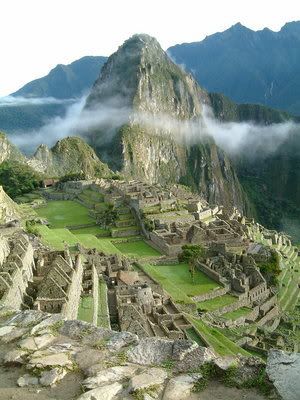
One interesting element of the city is not only the resilience of it's foundations to the elements (it was discovered at the turn of the 19th-20th century), but also the ways in which debates about restoration seemed very much alive in the tour. Our guide was of the opinion that ruins should remain ruins, there is something unique in how ruins enable more open interpretations that restoration tends to foreclose upon, ignoring the history of the site since its abandonment.
We rounded off the trip with mineral baths in the public hotspring pools in Aguas Calientes (a nearby town) and a really expensive burrito I bought (burritos are not Peruvian food, but I was feeling rushed to catch a train) made out of a crepe and lima beans.
Monday, April 4, 2011
Sunday, April 3, 2011
Jeremy Scahill vs. Liberal Imperialist Rhetoric
Jeremy Scahill, acclaimed for his history of Blackwater, argues against liberal defense of Libyan interventions:
Wednesday, March 30, 2011
Honduras: Continuing Unrest, Naked Statements
I really appreciated a recent article from the associated press that revealed the current Honduran president's sense of ownership over the current government of the country, responding to widespread protests and strikes lead by students, teachers, and healthcare workers.
He claims:
"They are trying to destabilize my government," Lobo said at a news conference. "All of this is part of an ideological strategy to provoke difficulties, especially now that there is the possibility of returning to the OAS at the next general assembly in June."
This reveals again the clientelist nature of politics in Honduras with its electoral power-sharing between liberal and conservatives and the way in which the changing of the guard always results in the reinforcement of the oligarchy's control of the nation.
Comments by the opposition support this analysis:
A coalition of Zelaya supporters called the National Front of Popular Resistance has called for a general strike Wednesday, threatening to escalate the conflict in the polarized and impoverished Central American country.
"Porfirio Lobo is once again revealing the fascist character of his government, which is trying to destroy popular organization and the gains of the people to impose an economic system that only benefits the oligarchy and multilateral companies," the front said in a statement.
He claims:
"They are trying to destabilize my government," Lobo said at a news conference. "All of this is part of an ideological strategy to provoke difficulties, especially now that there is the possibility of returning to the OAS at the next general assembly in June."
This reveals again the clientelist nature of politics in Honduras with its electoral power-sharing between liberal and conservatives and the way in which the changing of the guard always results in the reinforcement of the oligarchy's control of the nation.
Comments by the opposition support this analysis:
A coalition of Zelaya supporters called the National Front of Popular Resistance has called for a general strike Wednesday, threatening to escalate the conflict in the polarized and impoverished Central American country.
"Porfirio Lobo is once again revealing the fascist character of his government, which is trying to destroy popular organization and the gains of the people to impose an economic system that only benefits the oligarchy and multilateral companies," the front said in a statement.
Subscribe to:
Posts (Atom)