Showing posts with label Endless Distraction. Show all posts
Showing posts with label Endless Distraction. Show all posts
Wednesday, November 14, 2012

Saturday, November 3, 2012
Things I've Learned from Yoga Helpful for Bike Posture
To assume that anyone has as bad posture as me when doing anything would probably stretch the truth too far, but after an accident a year ago last September I had to relearn how to walk (apparently I've been walking with the wrong part of my foot, giving me duck walk generally), and as a result I wanted to share a few thoughts that might help other people understand better how to arrange one's body while on a bike, particularly in the conscious ways that yoga activates components of your body.


1) Abdominals and core are the seat of balance and weight:
If you're like me, you ride, or have rode, your bike putting equal weight on your ass (into your seat) and on your arms (particularly, your shoulders) making contact with the handlebars. You may be like me, in the panicky way I ride sometimes, and grip the handlebars too hard because of a secret fear that something will happen to yank them from your hands and you will go tumbling into some dangerous scenario.
Spending so much energy and strength on arm stability and load-bearing is counterproductive and sets you up for some nice carpal-tunnel/tennis elbow action that I currently have going on with my body.
Try and hold your handlebars as lightly as possible and get padded gloves--they reduce the amount of impact your hand and wrists take. If your bike is tuned up, most likely the way you balance on your seat can help determine the direction of your ride almost as much as the steering, so focus on pulling your core into your center (when you can pop up and off the seat easily without thinking about it means that you've effectively pulled your core toward center) for better overall balance and control of your bike.
Use your abs by to pull your weight over your pedals as you pedal standing up while climbing hills--again to get more pressure off of your arms. The added weight will make pedaling up hills easier too. The same applies when going downhill where you are most prone to brake hard. Use your abdominals to push your weight backwards over your seat so you don't need to bear weight and brake with the same part of your body.
Riding where the road is relatively flat, push your chest foward when pedaling to help keep your abs activated and to pull strain out of your lower and midback. Flatten your abdominals against your spine as you do this to reinforce the "puffed chest." Your upper torso can get a little fucked up from bicycling and needing to stabilize the bike and learning how to do the downward dog posture correctly can help you build an awareness of how working your abdominals, chest, and legs appropriately can help keep you balanced and reduce the wear and tear on your joints.

2) Some decent hardware can help
In an effort to reduce the load bearing role of your arms I prefer using bullhorn bars or short handlebars. Drop bars are not ideal in this regard. Moreover, with drop bars, if I want to sit upright in my bicycle seat, I tend to find the placement of brakes on drop bars to fairly awkward.


Making sure your brake cables are sufficiently tightened (this can often be done manually without tools, with a small tightening mechanism on the brakes themselves), that the pads are not thoroughly worn out, and the rubber isn't too old or stiff similarly produces reduced wrist crunching, which can prevent the later suck if you have any job that requires manual hand activities such as typing.

Making sure your brake cables are sufficiently tightened (this can often be done manually without tools, with a small tightening mechanism on the brakes themselves), that the pads are not thoroughly worn out, and the rubber isn't too old or stiff similarly produces reduced wrist crunching, which can prevent the later suck if you have any job that requires manual hand activities such as typing.
Using toe clip pedals or clipless pedals emphasize the correct part of your foot with which to pedal--the ball of your foot. One thing that long time bicycle commuters, bike messengers and the like will complain of is their knees are shot. To reduce strain on your knees it's crucial that you pedal through the ball of your foot. Getting the right kind of pedal can help you accomplish this.
Even you're pedaling with the correct half of your foot its easy to neglect using the ball. This is why I try to emphasize a loose flex of the foot as you pedal (from yoga)

It's also worth making sure you check your tires regularly and clean your chain regularly both will reduce the shock of impact your body will take from riding and reduce the force required from pedaling, making it easier on your knees.
3) And since we're discussing knees so much...
It's worth noticing where your knees go as you ride. It's much better that when you pedal your knees are running parallel rather than splayed out in opposite directions. Again this can wear out parts of your legs and knees in a corrosive way.
4) Hips...
Can also get really fucked from riding. I have some of the tightest, and therefore least flexible hips from years or riding. It's a good idea to learn how to do some stretches for these as they can really ache as you get older.

I recommend doing a modified pigeon pose while sitting at your desk after a commute. Here is what half-pigeon looks like:
Here is a video of a German woman telling you how to do pigeon pose:
Doing this at your desk operates on the same principle where you stack one ankle on the knee of the other leg (which is perpundicular to the floor). All the while flexing your foot you should press the knee of the raise leg toward the floor in order to begin opening your hips. Don't force your knee down but gradually increase the pressure you use in a gentle manner.
(Concluding caveat: And yes, I am appropriating a highly commodified version of an ancient practice while stripping it of its deeper religious significance such that I expend stress, knock out various knots and aches in my body, and then cry quietly to myself while I lay in corpse pose the end)
Monday, May 7, 2012
Saturday, March 17, 2012
Guatemala, Guatebuena, Guatemaya 2
(Again, title stolen from a Edelberto Torres-Rivas article)

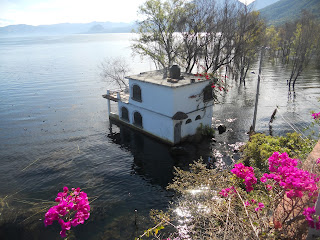


The night we returned from Chichicastenago J and I had a little talk about how much time we were spending travelling, how exhausting it was, and how neither of us was spending enough time relaxing by the lake. We made some preliminary plans to skip climbing the Volcano San Pedro the next day and committed instead to explore San Pedro and sit by the beach. Unfortunately after hitting the communal dinner and having a several carafe's of wine I took a bet from the twenty-something Canadian stoner across the table that J and I were going to climb San Pedro with him. My hubris at this moment, in spite of my agreement with my boyfriend, can partially be attributed to the alcohol which at times tends to bring out the braggart-y masculinist part of me that needs to prove things to others and always win arguments.
Apparently this Quebecois youth had made contact with a lancha pilot at the dock who had offered to sell him marijuana and also take him, along with whoever else, up San Pedro for a fee (much like many of the tour companies offered on Lago Atitlan). We assented although the incredibly-prolix stoner kid did not speak any spanish so I had to handle the call to this informal tour guide, who on the phone seemed pretty stoned himself. At the time is seemed like a fun idea, but as the evening progressed another moment of panic set in for me and J as our minds quickly turned to Guatemala's dispersed and systematically violent history (paramilitaries, death squads, 200,000 dead et al.) and we began to freak out a little bit. Moreover, another friend from Portland a hilarious punk woman, W, had sent us a very cryptic e-mail just before canceling the rest of her trip in Guatemala on account of being sick closing with the words "My friend Jenna says don't climb San Pedro." Since our tour books were like 5 years old they told us to get tourist police escorts when climbing San Pedro because it was often a place where bandits preyed on tourists. The cryptic last line from W (what the fuck did they see to say that?) and the suggestion of banditry again sent me reeling for a bit.

J with his indomitable will-power refused to believe any such thing after freaking out for a few minutes. I, on the other hand, spent the night wide wake trying to imagine every possible scenario and how I could extricate us with a little bit of fast-talking. The morning came and I hit the moment when I surpassed the fear. The guide showed up and I interrogated him on his credentials. I think our skepticism shook him a bit, but he handed us off twice to two other affiliated tour guides (apparently he was scheduled to pilot a lancha) the last of which was named Pancho or "'Cis" (short for Francisco), who ended up being the friendliest and most good humored tour guides I have ever encountered. He didn't speak any English but at this point J was feeling pretty confident about what he understood and had me ask questions, but was able to translate an impressive amount of Spanish. The altitude and thin oxygen managed to quiet the oppressively-loquacious Canadian to whom I had suggested, earlier in the day, that he inhabited the fortuitous life of someone out of a narcocorrido as his stories featured an universally recognition of him as a seasoned weed connoisseur and thus he was shown massive stashes of "gourmet" mota everywhere he went.
This left me and 'Cis to have long conversations about his Mayan heritage, the culture of Lago Atitlan, the poetry he enjoyed reading, and what he thought of the United States which were fascinating. The climb was beautiful and at the top (view seen above) we munched egg and roasted veggie sandwiches, basking in the sun, and semi-napping. No bandits to be found and in reality we didn't even need a guide as the trail was clearly marked and tourist police were posted a various points in the climb. 'Cis invited us back to his family's home in San Pedro where they treated us to hot chocolate that had been wrapped in orange leaves. His home very much reminded me of my childhood home in Mexico City with the corrugated aluminum roof and hand plastered concrete walls.

We said farewell to the incessantly talkative Canadian heading off to our hotel in San Pedro, Mikaso. This was probably one of the more expensive hotels we stayed at (amounting to I believe 700 quetzales that night plus breakfast for 2 people), but at the same time seemed worth it precisely because we were exhausted by the climb and needed a good hard rest and a clean shower. After a shower we wandered around San Pedro getting a mediocre meal at some expat bar with the word "Buddha" somewhere in the name (clearly expats from 1990s America). After wandering San Pedro proper looking for a cash machine observing the market, the church, and the basket ball court (the 1954 occupation of Guatemala by the United States fostered this one cultural export) we returned to the shore area (colonized by ex-patriots from Norway, the United States, Germany, Britain, and of course, as with any space of natural beauty in Latin America, Spanish hippies) to have amazing drinks (blended pineapple with cardamon and rum, and some sort of green and fresh ginger + another alcohol) at this little possibly Canadian-expat and his Chapin (what Guatemalan's colloquially call themselves) boyfriend's restaurante called La Ventana Azul, a place I hands down recommend if you ever go to Lago Atitlan.
Peaceful sleep and chill morning later J and I returned to Panajachel, the transit center of the lake, to catch a shuttle to Monterrico on the Pacific Coast. Here began the the trip's slump. I had insisted that we see the black, volcanic sand beaches of Guatemala, J wanted some beach time, and I thought it would be good to hit a space of Guatemala sans-tourists (it seems that often Mexicans and Central Americans spend time on the beach during the Christmas and New Years holiday). One onerous stupidity in my planning is for some reason I had thought that the travel to Monterrico would be an hour from Atitlan. This I discovered was not the case and shuttle took about 3 1/2 hours to get to the destination, on a fairly poor stretch of highway along the Pacific where the only traffic control mechanism were endless, unevenly built topes (speed bumps). We arrived to our expat owned hotel, this time a Norwegian man, with a much younger Guatemalan wife, and rushed to the beach for the last few hours of sun before the New Years' Eve festivities began. The beach and sunset to be sure were beautiful were it not for a mess of Middle Class Guatemalan's shit-talking us from afar, I wasn't clear on why.

Rocky evening continued as we scoured the town for somewhere to eat, passing cholos in low riders, and families finally deciding on an expensive non-buffet-style buffet where we were not allowed to grab extra-beans despite not consuming any of the meats they offered. After a few drinks and the crawling experience of mosquitos chomping away at our bodies, coming off of the mangrove swamp the surround the beach, we parked ourselves closer to the ocean watching the stars come out. As midnight approached we retreated to a bar for a bucket of beers and watched the NYE pyrotechnics as it seemed every beach town on the Pacific Coast was lighting up their own vernacular fireworks display which was amazing in a way no orchestrated 4th of July fireworks show seems to achieve in the United States. This may have been the highlight of the visit to Monterrico.
The next day we meandered around looking for a good beach spot and I realized the fundamental issue that emerges when you seek to avoid tourists altogether and you yourself are a tourist: people constantly give you looks the communicate "what the fuck are you doing here?" That coupled with the fact that J is rather muscular, large, Anglo in hair and eye color with a military style cut he probably looked like some Special Operations Forces trainer or at the very least a semi-imperialist gringo in look generated a significant amount of attention for J as we cruised around buying waters and snacks, something he found a little unnerving. We did find a nice relatively empty scrap of beach and watched Guatemalans sort of lay in the shallows like beached whales (culturally out hotel owner reminded us, it is not common for Guatemalan parents to teach their children to swim. One semi-irritating element that plagued us throughout the visit was the ladino families' enjoyment of endlessly driving all-terrain vehicles and dirt bikes up and down the beach.
Later in the day after looking for another meal and releasing some baby sea turtles from a nearby sea turtle sanctuary (what Monterrico is famous for really) we settled back at the hotel, already we could tell that 1 day was just about enough to take in Monterrico, and laid around under the mosquito net on our bed looking through our photos, when J realized that he was having sort of reaction to the hotel food: shitting his brains out as well as vomiting. The hotel which surrounded a modest pool filled with screaming children, with loudspeakers blasting salsa, and neighbors in the adjoining room having very loud sex amounted to J's nightmare evening. I medicated J to get his fever down, asked the hotel owner to turn down the music, and we managed to get some sleep eagerly awaiting the shuttle that would take us off to Antigua for J's last day in Guatemala. After breakfast I promptly shat my pants and had to quickly shower so that we might make our shuttle on time and get out of Monterrico. I should say to tourists that Monterrico is much more of a place for families and not really one of the more important places to visit in Guatemala.


Antigua, a more standard tourist destination, was only a few hours away by shuttle and the cooler mountain air helped us shake off the unnerving elements of our visit to Monterrico. It is colonial city, the former capital of Guatemala until earthquake wrecked significant components of the city's infrastructure, producing some really gorgeous ruins of former convents, monasteries, and a cathedral. In contrast to the humid, dub-step-drenched, bustle of Monterrico, Antigua Guatemala was a more peaceful hum of tourists, locals, and minor traffic on cobblestones. When compared to the life of the average Guatemalan Antigua appears to be a sort of middle class refuge in the mountains, which clearly has advantages of being fairly clean, I suppose it's safe (?), a few "apparent" 'mos walking around, but it also has the drawback of sheltering its residents (who are mostly ladino, i.e. mixed indigenous and Spanish/European) from the increasingly impoverished conditions of most of Guatemala that is at least 50% indigenous Maya (I've heard tell that the residents of Antigua work in Guatemala City and live in Antigua). We managed to see the most significant landmarks of Antigua on foot in about 8 hours, get some coffee, and have a really pleasant, altogether inauthentic, meal of paninis and Chilean wine in a garden restaurant that lost power halfway through our dinner.
Early the next morning J had to shuttle it to the Guatemala City airport in order to return to work. I had the advantage of hanging out in Antigua that morning perusing the market there, having some excellent coffee (most Guatemalan coffee is harvested for export, not much roasting goes on in the country) and finishing Asturias' El Señor Presidente. My friend, B, had e-mailed me earlier that she would return to Guatemala city early that day and I should meet her at her home in Zone 2. I caught another camioneta back to Guatemala city and then a cab through to B's apartment. B's apartment was a typical Latin American construction with a great deal of internal windows to seal off or to better circulate air. I was still feeling physically ill so we didn't do anything particularly challenging: we checked out the anthropological museum I had missed my first time around, ate vegetable lo mein and fried rice at one of Guatemala city's numerous Chinese restaurants, hit a Guatemalan thrift store (where all the thrift store clothes that don't sell in the United States go), bought a few books in Spanish on the subject of my dissertation, chatted a great deal, and watched the entire first season of Game of Thrones. Along our walks I got to check out the graffiti and public postering projects of HIJOS Guatemala a public memory project to address the coerced amnesia about the civil war, the disappearances that remain unsolved, and to some degree to maintain the legacy of militancy and revolutionary spirit of the demilitarized, destroyed guerrilla organizations. Here is one example that is upside down because I can't figure out how to rotate images on this blog (translates roughly as "Military Service, Cerebral/Mental Death"):

It was actually very cool to hang out in the city with B, it remapped the space for me and B's ease of moving throughout the central zones (no longer sexually harassed because she was with a man) made it a pleasure even if my guts did not agree. Visiting Guatemala was an amazing way to get a better sense of the cultural texture of some of the region even if I spend a significant amount of time in tourist destinations. At the very least my Spanish was very good toward the end. I think another trip is in order in the future to get a better handle on peoples, politics, and the organization of the society now that another military leader is in power.
Early the next morning J had to shuttle it to the Guatemala City airport in order to return to work. I had the advantage of hanging out in Antigua that morning perusing the market there, having some excellent coffee (most Guatemalan coffee is harvested for export, not much roasting goes on in the country) and finishing Asturias' El Señor Presidente. My friend, B, had e-mailed me earlier that she would return to Guatemala city early that day and I should meet her at her home in Zone 2. I caught another camioneta back to Guatemala city and then a cab through to B's apartment. B's apartment was a typical Latin American construction with a great deal of internal windows to seal off or to better circulate air. I was still feeling physically ill so we didn't do anything particularly challenging: we checked out the anthropological museum I had missed my first time around, ate vegetable lo mein and fried rice at one of Guatemala city's numerous Chinese restaurants, hit a Guatemalan thrift store (where all the thrift store clothes that don't sell in the United States go), bought a few books in Spanish on the subject of my dissertation, chatted a great deal, and watched the entire first season of Game of Thrones. Along our walks I got to check out the graffiti and public postering projects of HIJOS Guatemala a public memory project to address the coerced amnesia about the civil war, the disappearances that remain unsolved, and to some degree to maintain the legacy of militancy and revolutionary spirit of the demilitarized, destroyed guerrilla organizations. Here is one example that is upside down because I can't figure out how to rotate images on this blog (translates roughly as "Military Service, Cerebral/Mental Death"):

It was actually very cool to hang out in the city with B, it remapped the space for me and B's ease of moving throughout the central zones (no longer sexually harassed because she was with a man) made it a pleasure even if my guts did not agree. Visiting Guatemala was an amazing way to get a better sense of the cultural texture of some of the region even if I spend a significant amount of time in tourist destinations. At the very least my Spanish was very good toward the end. I think another trip is in order in the future to get a better handle on peoples, politics, and the organization of the society now that another military leader is in power.
Wednesday, February 29, 2012
Guatemala, Guatebuena, Guatemaya 1
(Title stolen from an article by Edelberto Torres-Rivas you can find here.)
I've been meaning to post some details of my 10 day trip to Guatemala here, but the increasing stress from dissertation elements and long distance relationship, coupled with a sense that blogs are decreasingly useful mediums for communicating has delayed me significantly.
Guatemala is a beautiful country with a systematically violent but also profoundly, richly political history. It is, by way of military, solidarity, and refugee discourses, a place think about somewhat in my dissertation. The motivations for going were therefore mixed. My boyfriend gets paid vacation time every year and he wanted a jaunt somewhere to help me at least "inhabit" the subject of my dissertation somewhat, even if that means I would be there having drinks and chilling by a giant, beautiful lake while reading about genocide. My friend B is also in Guatemala City (the capital) doing fieldwork for her anthropology PhD, so we had a potential person with who we could visit.
Because my bf doesn't have any free time in his job that demands he work 12 hour days, I did much of the planning on my own, consulting travel guides, friends, and also various internet review sites. Roughly sketched out the trip involved flying into Guatemala City, heading immediately out to Tikal, coming back to Guatemala City and shooting West toward Lago Atitlan for several days, hitting the Pacific Coast by way of Monterrico, spending a day and night in Antigua, back to Guate to see B. All compacted unrealistically into very little time.
Arrival in Guatemala City:
Pittsburgh is freezing during the Winter and it is also bleak, so banking off of clouds to see an overwhelmingly green landscape and warmth was a rather welcome sight. I had basically left us six hours to check out Anthropological Museums and eat in Guatemala City before catching a late night bus (on Linea Dorada) to Tikal. My plan was to get to a museum, stash our bags at the coat check, immerse ourselves in the anthropological material of the museum and then plan our next move, to hit a coffee or dinner, check el centro. We arrived the day after Christmas and I hadn't realized that the museums would be closed for a week for the holiday. We asked our cab driver to take us to another museum, which was also closed. Since we were near the center of town anyway we had him drop us off there so we could at least wander around and get some coffee or street food. I was at this point a little overtaken by panic, I foolishly internalize things like Guatemala's 200,000 genocide and the torture of thousands more as some sign that we too would be targeted and murdered, as obvious tourists. As irrational as I knew these feelings were, I couldn't quite keep my fear under control for the first hour or so in the city.
We managed to find a decent coffee shop and we wandered around the plaza which was lovely, strung with lights, vendors selling elotes, etc., a cathedral with a few minor nondescript monuments to the genocide, and well kept flowers. Avenida 6a running down from the center of the plaza has been closed off to automobile traffic producing a very pleasant pedestrian avenue where we familiarized ourselves with the various iterations of the faux hawk popular amongst the nations young men. We managed to find a vegetarian restaurant at the end of the avenue where we munched on odd, but not altogether bad veggie variations of guatemalan traditional foods like tamales (in this nation wrapped in banana leaves rather than corn husks, as in Mexico). We split some overpriced beers and caught our overnight bus. (Incidentally Guatemalan beers aren't very good, as with other Latin American nations lagers are the preferred form, but the Gallos and Mozas were not particularly tasty.)
The bus was packed and the bus ticketing agent giggled at my gigantic internet print out tickets. Linea Dorada operates what seems comparable to Greyhound buses in the United States with semi-reclining seats and powerful aire acondicionado. I managed to not sleep very well and the bf snuck our arms around each other beneath our blanket (note to the homos: Guatemala is not a tolerant nation for homosexual peoples, it's best to travel on the DL if you can, although it is much more common for heterosexual men to touch other men and put their arms around friends or loved ones in public more than in the United States).
Tikal:

In order to visit Tikal National Park, an archeological treasure of an ancient Mayan city sitting at the edge of the jungle, you first fly or bus into Flores, a small island town where you either obtain a bus to the site or enjoin a tour company to get you to the site and guide you through was is a very confusing set of paths where tourists lose their way annually. After working on some miscommunication with our tour company we managed to get a bus over to the site, and checked around for guides who spoke English, so that my boyfriend (J from here on out) could also understand the tour. The tour lasted three hours and the site was beautiful, massive and impressive temples rising out of the jungle, ancient Maya stelae, and the odor of copal (a pine sap incense) which seemed to permeate much of Guatemala or at least infected my senses for the duration of the trip.
For the remaining evening hours in Flores, J and I snuck into an alley to throw on swim trunks and we hit the lake surrounding Flores during at sunset. The lake is pleasantly cool, but warm enough that one could spend some time there. Our dinner was fine, a little overpriced and not as good as breakfast. My favorite meal in Guatemala tended to be breakfast tipico, which consists of two eggs, black beans, toast, chirmol (a non-spicy tomato onion sauce), and fried plantains. This breakfast is to be found everywhere in Guatemala for cheap in even the smallest comedores.
Toward Lago Atitlan:
We caught another overnight bus back to Guatemala City that night, arriving a half hour shy of 6am. Our guidebooks were fairly old, 2007 I believe was the most recent one we had between us, and we had plans to catch a camioneta to Panajachel, a city along Lago Atitlan, that morning from a particular site in Zone 1 Guatemala City. Our cab driver suggested that our books were wrong and the camionetas (or "chicken buses" as they are called by Anglos) picked up somewhere in Zone 8. Again I was confronted with a moment of First World panic (or maybe Mexican?--kidnapping is a national industry there) as I imagined another scenario in which we would again be robbed and murdered. We arrived and were told we need to catch a bus to a midpoint in Encuentros where we could catch a bus to Solola and onto Panajachel. Taking camionetas I think is a definitive experience for anyone visiting the country for the first time. These are former American school buses that are tricked out with bright colors, chrome plating, and have sound systems blasting reggeaton. Our driver looked like he was 19, his assistant 14, as they throttled up mountains at 90 mphs.

As we travelled through the rainy landscape we were treated to another Guatemala's surprising features: a wandering evangelical Protestant Preacher. For the course of an hour we were force fed a stream-of-consciousness sermon about finding Jesus amidst family tragedy and several songs. One feature of the counterinsurgency wars in Central America has been the increasing presence and power of evangelical Christianity both as a corrective to Vatican 2s enabling of liberation theology (a significant element of revolutions in Guatemala and El Salvador) and to defuse political energies elsewhere than resistance to the mandates of the landed oligarchy and the army. After switching buses twice at a fairly efficient rate (both buses were waiting to pick up passengers and almost immediately left after we boarded) we arrived at a sunbaked Panajachel. After getting our bearings, consuming coffee and breakfast, we loaded onto a lancha headed for a hotel I had arranged for us in the small village of Jaibalito. Lanchas are the cheapest way to get around the lake towns as the lake is surrounded by forested volcanos. Typically you load onto a lancha with 15-20 other passangers making stops at villages and towns along the way. Atitlan has to be one of the most beautiful natural locations I have ever been so riding in the lancha was a rather amazing way to see the bright blue of the lake and the life surrounding the water.
 Set in a beautifully manicured garden the hotel (called Vulcano Lodge) was a set of bungalows a bit off from the lake, and as soon as we arrived was the first time we had significant time to relax since the trip began. J and I snuck over to a neighboring hotel's patio/dock and spent the afternoon basking the beautiful surroundings, swimming, and reading, my recommended book of the trip El Presidente by Guatemalan novelist Miguel Angel-Asturias (which depicts the abjection and experience of living in the surveillance culture of a military dictatorship). As relaxing and restorative as the time at the lake was the way our hotel was set amidst a rather impoverished looking village with little in terms of public plumbing and not apparent school or medical services within reach (perhaps there is a hospital nearby)? It was a good reminder of the deeply inequitable and exploitative economic situation upon which the tourist economy sits in Guatemala (and also the degree to which the United States has been responsible for destroying its conduits for unrest about the inequality, as in overthrowing the first president to enforce a land reform).
The hotel offered a family-style meal with other residents and seeing no other options for eating dinner we joined what appeared to be several incredibly boring MidWestern American and their Canadian equivalents for dinner. The food was relatively good, even for two vegetarians, and with the dull families we agreed to share a shuttle the next day to visit Chichicastenago, a mountain town famous for it's large markets vending "indigenous" textiles, pottery, and other goods as well as for a still very active syncretic Maya-Catholic culture. We arrived relatively early to Chichicastenago so the longer we paced the streets, the more narrow they became as vendors divided the streets with proliferating stalls. Many of the textiles, for which Guatemala is famous, were clearly made in factory contexts and not really the handicrafts one might expect, which is not surprising but it didn't stop the vendors from haggling with you complaining about the lack of value "mi trabajo" was receiving. We bought a few really nice pieces, but as the streets became more claustrophobic the process of haggling made me incredibly anxious; anxious because of an awareness of my position as someone coming from the core of the world economy and all the privileges it affords me arguing for a better price against someone with less prospects, in all probability a shorter lifespan, in a language I failed to maintain because it was easier to learn English than to try and maintain any semblance of my culture in the overwhelmingly homogenous MidWest of the US. More tension emerged later, J had suggested we try and find some decent street food which seemed in short supply in the streets we were exploring. On finding on stall we purchased some small tortillas and warm black beans, seeing not much else for vegetarians to consume. A potentially homeless man shoved himself next to us asking for money and a few tortillas, which spurred a fight between me and J over why I let said dude paw the food we had only just begun to eat. After a fight and a long session of lesbian-style processing we decided that despite the very cool tapestry we bought and getting a chance to see the interior of its Maya-Catholic church (reeking of copal incense) Chichi should have been a 3 hour trip, not one lasting the whole of a day.

I've been meaning to post some details of my 10 day trip to Guatemala here, but the increasing stress from dissertation elements and long distance relationship, coupled with a sense that blogs are decreasingly useful mediums for communicating has delayed me significantly.
Guatemala is a beautiful country with a systematically violent but also profoundly, richly political history. It is, by way of military, solidarity, and refugee discourses, a place think about somewhat in my dissertation. The motivations for going were therefore mixed. My boyfriend gets paid vacation time every year and he wanted a jaunt somewhere to help me at least "inhabit" the subject of my dissertation somewhat, even if that means I would be there having drinks and chilling by a giant, beautiful lake while reading about genocide. My friend B is also in Guatemala City (the capital) doing fieldwork for her anthropology PhD, so we had a potential person with who we could visit.
Because my bf doesn't have any free time in his job that demands he work 12 hour days, I did much of the planning on my own, consulting travel guides, friends, and also various internet review sites. Roughly sketched out the trip involved flying into Guatemala City, heading immediately out to Tikal, coming back to Guatemala City and shooting West toward Lago Atitlan for several days, hitting the Pacific Coast by way of Monterrico, spending a day and night in Antigua, back to Guate to see B. All compacted unrealistically into very little time.
Arrival in Guatemala City:
Pittsburgh is freezing during the Winter and it is also bleak, so banking off of clouds to see an overwhelmingly green landscape and warmth was a rather welcome sight. I had basically left us six hours to check out Anthropological Museums and eat in Guatemala City before catching a late night bus (on Linea Dorada) to Tikal. My plan was to get to a museum, stash our bags at the coat check, immerse ourselves in the anthropological material of the museum and then plan our next move, to hit a coffee or dinner, check el centro. We arrived the day after Christmas and I hadn't realized that the museums would be closed for a week for the holiday. We asked our cab driver to take us to another museum, which was also closed. Since we were near the center of town anyway we had him drop us off there so we could at least wander around and get some coffee or street food. I was at this point a little overtaken by panic, I foolishly internalize things like Guatemala's 200,000 genocide and the torture of thousands more as some sign that we too would be targeted and murdered, as obvious tourists. As irrational as I knew these feelings were, I couldn't quite keep my fear under control for the first hour or so in the city.
We managed to find a decent coffee shop and we wandered around the plaza which was lovely, strung with lights, vendors selling elotes, etc., a cathedral with a few minor nondescript monuments to the genocide, and well kept flowers. Avenida 6a running down from the center of the plaza has been closed off to automobile traffic producing a very pleasant pedestrian avenue where we familiarized ourselves with the various iterations of the faux hawk popular amongst the nations young men. We managed to find a vegetarian restaurant at the end of the avenue where we munched on odd, but not altogether bad veggie variations of guatemalan traditional foods like tamales (in this nation wrapped in banana leaves rather than corn husks, as in Mexico). We split some overpriced beers and caught our overnight bus. (Incidentally Guatemalan beers aren't very good, as with other Latin American nations lagers are the preferred form, but the Gallos and Mozas were not particularly tasty.)
The bus was packed and the bus ticketing agent giggled at my gigantic internet print out tickets. Linea Dorada operates what seems comparable to Greyhound buses in the United States with semi-reclining seats and powerful aire acondicionado. I managed to not sleep very well and the bf snuck our arms around each other beneath our blanket (note to the homos: Guatemala is not a tolerant nation for homosexual peoples, it's best to travel on the DL if you can, although it is much more common for heterosexual men to touch other men and put their arms around friends or loved ones in public more than in the United States).
Tikal:

In order to visit Tikal National Park, an archeological treasure of an ancient Mayan city sitting at the edge of the jungle, you first fly or bus into Flores, a small island town where you either obtain a bus to the site or enjoin a tour company to get you to the site and guide you through was is a very confusing set of paths where tourists lose their way annually. After working on some miscommunication with our tour company we managed to get a bus over to the site, and checked around for guides who spoke English, so that my boyfriend (J from here on out) could also understand the tour. The tour lasted three hours and the site was beautiful, massive and impressive temples rising out of the jungle, ancient Maya stelae, and the odor of copal (a pine sap incense) which seemed to permeate much of Guatemala or at least infected my senses for the duration of the trip.
For the remaining evening hours in Flores, J and I snuck into an alley to throw on swim trunks and we hit the lake surrounding Flores during at sunset. The lake is pleasantly cool, but warm enough that one could spend some time there. Our dinner was fine, a little overpriced and not as good as breakfast. My favorite meal in Guatemala tended to be breakfast tipico, which consists of two eggs, black beans, toast, chirmol (a non-spicy tomato onion sauce), and fried plantains. This breakfast is to be found everywhere in Guatemala for cheap in even the smallest comedores.
Toward Lago Atitlan:
We caught another overnight bus back to Guatemala City that night, arriving a half hour shy of 6am. Our guidebooks were fairly old, 2007 I believe was the most recent one we had between us, and we had plans to catch a camioneta to Panajachel, a city along Lago Atitlan, that morning from a particular site in Zone 1 Guatemala City. Our cab driver suggested that our books were wrong and the camionetas (or "chicken buses" as they are called by Anglos) picked up somewhere in Zone 8. Again I was confronted with a moment of First World panic (or maybe Mexican?--kidnapping is a national industry there) as I imagined another scenario in which we would again be robbed and murdered. We arrived and were told we need to catch a bus to a midpoint in Encuentros where we could catch a bus to Solola and onto Panajachel. Taking camionetas I think is a definitive experience for anyone visiting the country for the first time. These are former American school buses that are tricked out with bright colors, chrome plating, and have sound systems blasting reggeaton. Our driver looked like he was 19, his assistant 14, as they throttled up mountains at 90 mphs.

As we travelled through the rainy landscape we were treated to another Guatemala's surprising features: a wandering evangelical Protestant Preacher. For the course of an hour we were force fed a stream-of-consciousness sermon about finding Jesus amidst family tragedy and several songs. One feature of the counterinsurgency wars in Central America has been the increasing presence and power of evangelical Christianity both as a corrective to Vatican 2s enabling of liberation theology (a significant element of revolutions in Guatemala and El Salvador) and to defuse political energies elsewhere than resistance to the mandates of the landed oligarchy and the army. After switching buses twice at a fairly efficient rate (both buses were waiting to pick up passengers and almost immediately left after we boarded) we arrived at a sunbaked Panajachel. After getting our bearings, consuming coffee and breakfast, we loaded onto a lancha headed for a hotel I had arranged for us in the small village of Jaibalito. Lanchas are the cheapest way to get around the lake towns as the lake is surrounded by forested volcanos. Typically you load onto a lancha with 15-20 other passangers making stops at villages and towns along the way. Atitlan has to be one of the most beautiful natural locations I have ever been so riding in the lancha was a rather amazing way to see the bright blue of the lake and the life surrounding the water.

The hotel offered a family-style meal with other residents and seeing no other options for eating dinner we joined what appeared to be several incredibly boring MidWestern American and their Canadian equivalents for dinner. The food was relatively good, even for two vegetarians, and with the dull families we agreed to share a shuttle the next day to visit Chichicastenago, a mountain town famous for it's large markets vending "indigenous" textiles, pottery, and other goods as well as for a still very active syncretic Maya-Catholic culture. We arrived relatively early to Chichicastenago so the longer we paced the streets, the more narrow they became as vendors divided the streets with proliferating stalls. Many of the textiles, for which Guatemala is famous, were clearly made in factory contexts and not really the handicrafts one might expect, which is not surprising but it didn't stop the vendors from haggling with you complaining about the lack of value "mi trabajo" was receiving. We bought a few really nice pieces, but as the streets became more claustrophobic the process of haggling made me incredibly anxious; anxious because of an awareness of my position as someone coming from the core of the world economy and all the privileges it affords me arguing for a better price against someone with less prospects, in all probability a shorter lifespan, in a language I failed to maintain because it was easier to learn English than to try and maintain any semblance of my culture in the overwhelmingly homogenous MidWest of the US. More tension emerged later, J had suggested we try and find some decent street food which seemed in short supply in the streets we were exploring. On finding on stall we purchased some small tortillas and warm black beans, seeing not much else for vegetarians to consume. A potentially homeless man shoved himself next to us asking for money and a few tortillas, which spurred a fight between me and J over why I let said dude paw the food we had only just begun to eat. After a fight and a long session of lesbian-style processing we decided that despite the very cool tapestry we bought and getting a chance to see the interior of its Maya-Catholic church (reeking of copal incense) Chichi should have been a 3 hour trip, not one lasting the whole of a day.

Thursday, January 26, 2012
Americana as contemporary obsession...
...just as America would appear to be going into a decline. Dave Cole's art below seems to interact with the growing trend toward an archival American "heritage," particularly amongst white, college educated youth. I think this sculpture captures something of it's provincial quality, it's danger of mutual nullification, and the malignant undercurrent on top of which it sits.
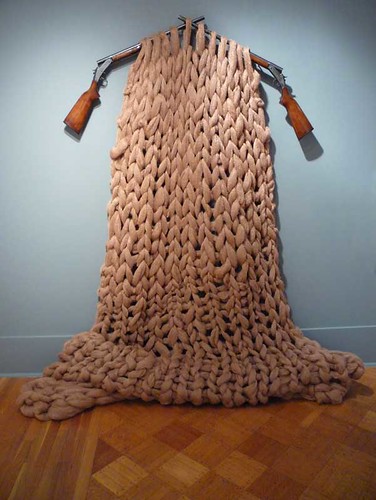
http://davecoledavecole.com/projects-loaded-shotguns.php
Wednesday, January 11, 2012
Child Abuse, to go along with Syllabus Building
...and its hopeless vicissitudes
(I love this video)
Sunday, January 8, 2012
Sunday, December 18, 2011
Not Allowed: Hats Festooned with Animal Ears, for Adults

There has been a rash of wearing winter hats, over the last few years, with all sorts of animal-like adornment, most popularly hats with some sort of mammalian-ears (cats, fox, etc) that seem to infantilize its wearers. This has been particularly noticeable at various Occupy movements throughout the country, which has struck me the wrong way. Not because I want to use a fashion accessory to critique the underlying seriousness of the protests. I'm not going to do that, because then I might sound like Roger Ebert's (glib) recent post on Occupy Wall Street that suggests his utter lack of understanding of the motivations of these protests, just how out-of-touch he is with the status working and poor America, and just another reason why we don't turn to mediocre film critics for appropriate political vectors (I might be stabbing myself in the back with this last statement). I am clearly someone who supports these movements and sees them as the far-left return to the focus of politics for which I have waited all of these years. Fuck arguments about how we look as indicative of the credibility of our politics. But...
Get it the fuck together youth of America! Being "cute" in the sense of being 4 years-old is not useful, but is embarrassing! YOU ARE NOT A CHARACTER OUT OF A JAPANESE ANIME CARTOON!
Wednesday, December 14, 2011
Sunday, November 6, 2011
Monday, October 31, 2011
Thoughts on Punk and Race, from the Editors of White Riot

In an interview with souciant.com:
SD: The thing is, a lot of punks of color will talk
about the fact that as they slipped their given identity and took on
the mantle of punk, they’d get crap from people asking, essentially,
“What, are you trying to be white?” So punk is identified as white and
therefore it becomes very complicated for them. Here’s this way that
through their agency they can adopt a race-less identity — at least
that’s the ideal — which is, “I’m punk,” yet it is seen both by people
from their own ethnicity and, unfortunately, white punks as being
white. And that gives them a lot of anxiety. Now what James Spooner has done with Afro-punk and a lot of the folks in the Race Riot zine."
(White Riot, out on Verso).
(White Riot, out on Verso).
Sunday, October 30, 2011
October 30th, 1950; Puerto Rico's Nationalist uprising

Friday, September 30, 2011
Thursday, September 22, 2011
Hearts of Darknessess + Shitface
Movie Trailer for a collaboration between band Hearts of Darknessess and filmmaker Shitface.
Monday, September 12, 2011
State of Exception Discourse, It's Problems
Michael Hardt discussing how claims about "sovereign power" as based on "a state of exception" (e.g. Abu Ghraib, the new jurdical category of "enemy combatant" that enables torture, etc., preemptive defense) is always governed by a constitutionalist tendency, a desire for the rule of law, rather than any ethos that might be revolutionary, or transform the conditions for such exceptions:
Sunday, September 11, 2011
Monday, September 5, 2011
Thursday, September 1, 2011

Tuesday, August 23, 2011
Judith "Jack" Halberstam and the It Gets Better Project

At the same time, in Western countries, Halberstam argued, that gender norms, particularly those of women, have been scrambled by models of transgenderism, insofar as 51% of women over 45 in the United States are single, suggesting something fundamentally askew in the production of feminine subjects, ready for state legibility. Instead, Halberstam promoted some notion that gender is a kind of ecology, wherein we might migrate to differential performances of gender and sexual life depending on where we are in life, and how we transform.
None of these claims are particularly revolutionary, and none I particularly took issue with. The notion of gender as ecology makes a great deal of sense particularly with regard to the constant extension of human life in time might suggest a temporal evolution of sexuality and gender identity.
I questioned "Jack" with regard to "imposition" of gender/sex norms as being completely uniform, insofar as groups in Uganda fighting the execution ban have attempted to "take refuge" in LGBT set of identities at least to appeal for international aid against the law. Halberstam reminded me that it was U.S. pastors who helped initiated or at least fostered this law in Uganda in the first place, something I was already aware. But here is the problem with that argument:
On the one hand the state imposes a sexuality on its subjects and this is done with the aid and abeyance, perhaps initiative, of an imperialist/missionary element from the United States. Somehow LGBT groups in the West are responsible or complicit with this process in Uganda because they insist on identification with their categories and cause in order for those suffering under the threat of the new legislation and massive social intolerance to receive succor or aid, and they thus quash the fragile ecologies of gender/sexual life in these other nations. But at the same time, were this law to have passed, as soon as the subjects were to have emerged, i.e. identified themselves, power could do nothing productive with them, but to kill them (which at least for Foucault, the floating influence behind her argument, would be a rather unproductive use of power). LGBT groups operating within a liberal imperialist tradition are therefore retroactively to blame for these deaths which do not really mobilize more bodies ready for governance, or biopolitical regulation, but only death.
Halberstam closed her talk with a discussion of Dan Savage's "It Gets Better Project" that made some rather scattershot and I would say fucked up claims. She suggested that "It Get's Better" is a project that is comensurate with a cultural of neoliberalism, that insists on a generalized faith in the "future," as in market futures will generate profit and social equity if we only have faith in them. This was a claim that garnered at least my tacit assent, but then Halberstam seemed to indicate that somehow the rash of finally publicized suicides (queer teens are 75% more likely to attempt suicide than heterosexual teens) by imputedly gay teens were not a socially significant phenomenon because the suicides were just boys.
This last comment pissed me off to a significant degree, for obvious reasons, in large part due to the fact that outwardly perceived gay men, tend to be the object of public scorn and violence more often than lesbian women in the United States. Her suggestion to my mind seemed like a sort of knee-jerk reaction of a former 1970s radical feminist attitude that treats all men as pristine representatives of the patriarchy. At time, I will admit I thought there was something somewhat cute for me in the "It Gets Better Project," a reaching out across queer generations in a way that queer life in the U.S. tends to prohibit or make untenable.
Later in the year, Dan Savage came to town to discuss this project and basically give a live version of his column "Savage Love," a largely sexual and relationship advice column with national attention. And although I loathed and found completely disagreeable some of Halberstam's grisly conclusions, I have to say that her argument that Savage's project was commensure with neoliberal culture held.

Subscribe to:
Posts (Atom)