Interesting piece by Nebojsa Seric Shoba commenting on the startling presence of the United States in geopolitics, and its capacity to illuminate in contrast to the dark world over which it can illuminate, from which it derives the resources to illuminate:
Showing posts with label Art. Show all posts
Showing posts with label Art. Show all posts
Thursday, May 10, 2012

Thursday, January 26, 2012
Americana as contemporary obsession...
...just as America would appear to be going into a decline. Dave Cole's art below seems to interact with the growing trend toward an archival American "heritage," particularly amongst white, college educated youth. I think this sculpture captures something of it's provincial quality, it's danger of mutual nullification, and the malignant undercurrent on top of which it sits.
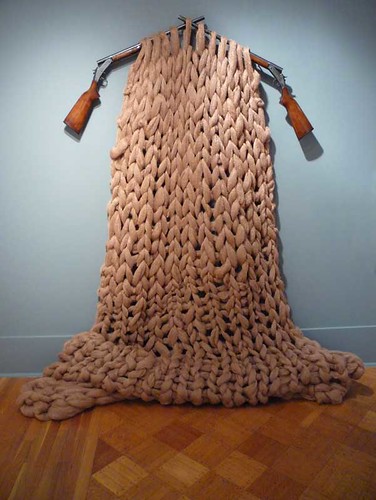
http://davecoledavecole.com/projects-loaded-shotguns.php
Wednesday, January 11, 2012
Child Abuse, to go along with Syllabus Building
...and its hopeless vicissitudes
(I love this video)
Friday, September 30, 2011
Thursday, September 22, 2011
Hearts of Darknessess + Shitface
Movie Trailer for a collaboration between band Hearts of Darknessess and filmmaker Shitface.
Monday, July 25, 2011
Monday, July 11, 2011
War/Art/Machines
A fascinating piece by artists duo Allora & Cazadilla featured in the U.S. pavillion at the Venice Biennial:
An innocent performance laced with political themes is what audiences will experience in Venice. The tank, from 1945 and used in the Korean War, will sit outside the pavilion. There, a USA Track & Field athlete in uniform will run for about 45 minutes on the treadmill above its right track. The associations are many: militarism, national identity, competition.
Also, check out their interview with on PBS' Art 21 show. Here is an excerpt from an interview with the couple discussing another war themed piece entitled 'Clamor:'
"What triggered this piece was our interest in how people use music or sound as a weapon—how you can have a gun made of sound that can immobilize you. Then we started getting interested in the relationship between sound or music and war. Our research opened up an enormous quantity of material related to this idea, an incredible archive of sounds related to war—from actual combat, where music was historically used to command and control troops, to more contemporary uses such as propaganda to instill patriotism.
[...]
Interestingly enough, in the history of military music, one of the ways they describe the instruments’ function on the battlefield is to create a clamor. They’d create a noise that was so unbearable for the opponent that it would actually distract them and keep them from being able to effectively fulfill their job of fighting.
It’s described by one Crusader as comprising trumpets, clarions, horns, pipes, drums, cymbals, a prodigious array creating a horrible noise and clamor. And he says they did this to excite the spirit and their courage—for the more violent the clamor became, the more bold they were for the fray.
We’re trying to reinvigorate this word, to redirect it to a new end in this exhibition. We want to talk about the global state of war of today—something that resonates with contemporary experience."
Thursday, July 7, 2011
Jean-Luc Godard's Commercial for Schick
A central figure in France's mid-20th century Nouvelle Vague film movement, Jean-Luc Godard made a commercial for Schick. This would seem a break with Godard's relatively overt anti-capitalist politics, in films such as La Chinoise, wherein French Students under the auspices of Maoism form a revolutionary cell and begin carrying out assassinations.
Nicholas Rombes writes about it over at the Rumpus in his Art Film Roundup:
Schick was owned by ultra-Conservative, capitalist extraordinaire Patrick Frawley. Does this matter, that Godard made a commercial to help sell products for a company whose profits supported political causes antithetical to his own? We are all complicit in these hypocrisies, small and large, as we use and consume objects each day whose sources in the global matrix are often obscure. If Godard made the commercial to help fund his more radical projects (perhaps Tout va bien, the following year?) then do the two projects cancel each other out? Is there some sort of ledger to keep track? Is it okay to denounce the enemy, and then collaborate with the enemy, as long as you can come up with some sort of intellectual rationalization for your actions?
Here at Filmmaker, Zach Wigon writes about Godard and the role of the socially-engaged director. His lede:
Jean-Luc Godard was a guest at the University of Southern California in 1968, discussing his work on a panel with King Vidor, Roger Corman, Peter Bogdanovich and Sam Fuller. This was at the close of a cinematic decade that Godard had owned; now, breaking with his previous work, he was becoming more political and less accessible. One of the discussion’s most telling moments came toward the end, when an audience member asked, “Monsieur Godard, are you more interested in making films or making social commentary?” Godard coolly replied, “I see no difference between the two.”
I think the discussion from Inpursuitofsilence blog has a few interesting points to make on the commercial:
As is Godard’s seductive way, the subject of the mini-scenario is a gorgeous young couple. In this case, a man and woman rising from bed in the morning light, already deep into a noisy spat, which is compounded by loud shifting electroacoustical broadcaster and music tracks. The fight gets noisier and the din gets uglier as they proceed, in tandem, into the bathroom. And then, at a certain point, the man picks up the bottle of aftershave, pops the lid and — abracadabra! — the broadcasts vanish; the fight ends; there’s a second or two of silence, before the woman expresses her appreciation of the scent. She takes the bottle, smells, and the commercial closes with soft, wet kisses.
It’s amusing, effective — and weirdly evocative of where we are now as a culture. If we have the means, we buy our quiet, if not quite in the form of a geni in a bottle of aftershave, in “quiet products” that can shave a handful of decibels off the noise of vacuum cleaners, dishwashers and the like for considerably more money than their rattling, roaring rank and file appliance-cousins cost. We purchase spa sessions and soundproofing technology and other miracles of padding, muffling, filtering and muting — the velvet, noise-cancelling armor that the affluent don to charge the world, or to flee the chase. But what about everyone else? All those people who lack resources (educational as well as financial) to perform their own sonic schick trick?
Thursday, June 23, 2011

Friday, May 6, 2011
Tuesday, April 19, 2011
Peru, Part 1: Aguantando Los Andes
I've been waiting to revisit my trip to Peru mostly because of pressure to get back into school work and to face the mountain of grading I had piling up on the days I spent not working, but I guess I have a moment tonight to spend some time deliberating on the things I've gleaned from Peru.
The more I look back on the trip the more it seems to culminate a lot of the ongoing processes of life for me in generative and positive ways.
I decided to educate myself more about Peru, it's history, and the struggles between left-guerillas in the countryside and an increasingly authoritarian state all verge on issues I want to explore for the dissertation, although mostly tangentially. Peru had a rather unique group emerge out of the late-70s/early-80s insurrectionary struggles going on throughout Latin America. They were dubbed Sendero Luminoso (The Shining Path), a break off group from other Maoist currents in Peru at the time. It's leader, a former political philosopher, Abimael Guzmán, insisted on the necessity of crossing "the river of blood" into a glorious post-capitalist world for which Peru was its threshold. This meant a strategy of attempting to choke the remnants of colonial social relations, capitalist exploitation, and neo-colonial arrangements from the society and the people through guerilla operations, reeducation, and terrorism. I don't know enough about them to say much beyond that their rhetoric seems born of a kind of mode of prophecy as much as politics, as killing in the name of the future seems to be highly valued for Sendero Luminoso (see Vice Magazine's article on contemporary musical dispatches from the group). Mario Vargas Llosa, the most recent winner of the Nobel Prize for literature, and perhaps one of the more right-wing members (he ran for president of Peru once on a neo-liberal platform, ugh!) of, what America's literary public likes to define as Latin America's New Narrative form, has written a novel on the issue called Lituma en Los Andes or Death in the Andes which I am still reading despite having visited Peru over a month ago. Llosa apparently once got into fisticuffs with Gabriel Garcia Marquez, perhaps over Marquez's wife (this part could be a rumor), in the Museo de Bellas Artes in downtown Mexico City.
The Inca too, offer a unique counterpoint to some of my thinking about the indigenous histories of Latin America (I have read mostly about Meso-American peoples and their traditions) insofar as the history of human sacrifice seems highly contested (between my tour guides of various destinations, but also a short piece I read from a feminist anthropologist). Apparently although their societies enforced strict gender segregation and roles, they tended to be roles with a great deal of gender parity, insofar as women served similar ritual roles as men with gender specific power and knowledge-sharing kinship structures. Women in these powerful roles were then targeted by the Spanish Inquisition post-conquest as witches.
However, despite the militaristic missionary work of much of the Spanish empire the emissaries from Spain encouraged and pursued aesthetic cultural syncretisms with Andean/Inca culture to facilitate conversion. I saw a great deal of this fascinating cultural blending in the facades of churches and cathedrals throughout the country (in one case I was informed that St. James, who was in some cases interpreted as the Moor killer, was repurposed as a ritual figure for the practice of Andean black magic).
The Spanish also had a difficult time destroying what were the foundations on Incan temples, buildings, and city walls so instead they often built on top of them. We saw a number of churches and walls in the Sacred Valley and in Cusco built on the former Incan foundations.
Cusco (or the "navel"), formerly a major city for the Inca, was our first significant stop of the trip before the hitting the Inca trail. It is a beautiful city involving a great deal of Spanish colonial architecture, lush plazas, and an altitude that might inspire illness (I had a headache for the duration of our stay). It is replete with tourists and those catering to tourism (too many pizza shops to count) which is after all one of Peru's largest industries. In addition to tourists and those in the tourism industry (including young women who would not stop offering massages) we encountered those who kept to some element on Andean native traditions: women with braids, wearing fedoras, and traditionally patterned sarapes in which they carried goods for sale or their children, kids carrying baby goats and lambs insisting that you hold them for a photo for a few soles (Peru's currency).
The soundtrack I would have stuck with was this volume of Peruvian cumbias (Afro-Latin rock) from the 1960s titled The Roots of Chicha, which I heard throughout the trip. My iPod broke on the plane ride, which was fine as I was on a hiatus from technology for the whole trip. This was one of the better decisions I made.
Regardless, I did prepare for the trip by imbibing this album in the weeks leading up to the trip. A decent track I would recommend from this album is as follows:
Another noteworthy and fascinating artist from Peru is Yma Sumac who had a five octave voice and I unfortunately discovered her only after the trip had ended. A few examples of her extraordinary and eerie talents below:
One of the drawbacks of the trip that was simultaneously a benefit for me was that we were traveling a group of people, the reason behind the trip affordability, few of which understood Spanish and even fewer who spoke any semblance of the language. Although the trip itinerary had been prepared ahead of time there are of course a numberless set of interactions one has to have in order to figure out where one is headed, confirmations, questions, and difficulties that arise as one travels. I was responsible for translating on almost all of these occasions. This pushed me to practice my Spanish a great deal. Although at times I resented it I think this experience made me feel like a more adequate traveller, someone who can handle and take care of themselves in Latin America with a little research and some occasionally tortured grammatical constructions. The only times I wanted to strangle the other travelers in my group was when they insisted I help them haggle for fractions of the dollar off of stupid shit they were buying, and forgetting that I wasn't being paid to help them in the first place, i.e. making stupid demands for my skills.
After a day in Cusco we awoke early to hit the trailhead of the Inca Trail to Machu Picchu. When we arrived after several stops and starts it was revealed that some of us had the wrong tickets for the type of traveller we were and thus 3 of us could not proceed onto the trail (for those of you thinking you are a graduate student and deserve to pay student prices for admission in Peru you should note that if you are 25 or older you are too old to be considered a student, unlike in the United States and Europe). This fact was devastating for the 3 left behind as the trip was centered around this element of Peru to begin with and for whatever opaquely bureaucratic reason they were not allowed to pay the remainder owed for a different ticket. Nor could they purchase tickets for any of the following days because the government limits the number of hikers on the trail, requiring that travelers prebook tickets.
Despite this setback I have to say the hike was challenging, beautiful, and fascinating. My boyfriend, his friend Becca, and I seemed to take to the altitude pretty well despite my constant headache and so we stayed ahead of the other hikers in our group most of the time, giving us space to talk as we liked and enjoy the sights together. It was the end of the rainy season so clouds were pouring over the mountains like rivers of the air making the hike between and around them all the more dramatic. The Inca believed (or so I was told) that the mountains were holy so the hike was more of a pilgrimage through the mountains and their passes, moving through multiple ecosystems and temperatures along the way on the way to Machu Picchu.
The second day was by far the most physically challenging. The altitude and steepness of the climb (which incidentally the trail is made out of uneven stone stairs carved by the Inca) made the highest points difficult to maintain a steady pace for very long. The lack of oxygen at times made my limbs feel as if they were heavier and more difficult to move. Towards the end of the highest pass we were stopping every 20 feet or so to catch our breaths, but with every break we felt completely rejuvenated and ready to tackle more. At the highest point that day the bf, Becca, and I looked at each other, bundled up against the cold and laughed at the joy of the accomplishment.
A note about the labor that made this trip possible: So even as we were looking at each other happy and satisfied by the hard work it took us and our backpacks up the hill, we had to notice the porters who were resting around us as well. The Peruvian government mandates that everyone who enters the Inca trail has to have a porter that goes along with them. I am not clear on the reasoning for this, perhaps, it just frees up a bunch of seasonally available jobs. If you are part of a tour group which most everyone was, they arranged this for you. The porters for our group carried food, cooking supplies, and tents which they set up before we arrived at the campsites. They usually kicked our asses on the trail, usually with nothing more than a sweater, shorts, and a pair of canvas golas scampering across slippery stairs. This reality made me relatively uncomfortable, several of us got together to put together some decent tips for the porters (because it turns out they don't make a great deal of money for 4 days of labor) and I was enjoined to make a speech to honor their labors (again as the only Spanish speaker) where I got to acknowledge this even as there seemed little I could do beyond this.
The rest of the hike which probably could have been consolidated into fewer days was peppered with smaller Incan ruins along the trail either food depots or guard towers (the tour guides seemed to be at odds about which at certain points), and amazing Incan mountainside terracing that we could see as the clouds slid across the faces of mountains and cliffs. The Inca also carved smooth rectangular tunnels into rock faces to ease the trail through which we easily passed, amidst rainforest limbs dripping with vegetation, moss, and moisture. On the last day we waited at the Sun Gate to see if the clouds would part so we could behold Machu Picchu from a good distance. Seeing the pockets of air open up the clouds and the former Incan city was really pretty amazing at the moment, mostly because we had been immersed in its environment for so long, and that we had worked to get there. I unconsciously approach tourism scenarios, I think most consumers of Western media do this, like I would instances in which I am a spectator--with a half-bored interest. Marching up the trail made seeing the city that much more spectacular.
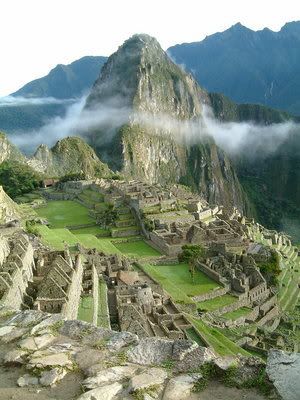
One interesting element of the city is not only the resilience of it's foundations to the elements (it was discovered at the turn of the 19th-20th century), but also the ways in which debates about restoration seemed very much alive in the tour. Our guide was of the opinion that ruins should remain ruins, there is something unique in how ruins enable more open interpretations that restoration tends to foreclose upon, ignoring the history of the site since its abandonment.
We rounded off the trip with mineral baths in the public hotspring pools in Aguas Calientes (a nearby town) and a really expensive burrito I bought (burritos are not Peruvian food, but I was feeling rushed to catch a train) made out of a crepe and lima beans.
Wednesday, March 16, 2011
Voces De Cambio
An interesting vernacular visual/literacy project:
"Voces de Cambio (Voices of Change) is an extraordinary after-school program for teenage girls in Quetzaltenango, Guatemala. Since 2006 the program has used writing and still photography to help teenage girls explore issues such as discrimination, gender equality, youth leadership, and civic engagement."
(Another instance of the NGO-ification of empowerment politics?)
Wednesday, November 10, 2010
Joe Diebes
Visual and sound artist Joe Diebes explores in this video the ways in which musical virtuosity can approximate and approach the mechanical, and machine-like:
excerpt from Scherzo from Joe Diebes on Vimeo.
Subscribe to:
Posts (Atom)