Showing posts with label Disseration. Show all posts

Saturday, March 17, 2012

Guatemala, Guatebuena, Guatemaya 2

(Again, title stolen from a Edelberto Torres-Rivas article)

The night we returned from Chichicastenago J and I had a little talk about how much time we were spending travelling, how exhausting it was, and how neither of us was spending enough time relaxing by the lake. We made some preliminary plans to skip climbing the Volcano San Pedro the next day and committed instead to explore San Pedro and sit by the beach. Unfortunately after hitting the communal dinner and having a several carafe's of wine I took a bet from the twenty-something Canadian stoner across the table that J and I were going to climb San Pedro with him. My hubris at this moment, in spite of my agreement with my boyfriend, can partially be attributed to the alcohol which at times tends to bring out the braggart-y masculinist part of me that needs to prove things to others and always win arguments. 

Apparently this Quebecois youth had made contact with a lancha pilot at the dock who had offered to sell him marijuana and also take him, along with whoever else, up San Pedro for a fee (much like many of the tour companies offered on Lago Atitlan). We assented although the incredibly-prolix stoner kid did not speak any spanish so I had to handle the call to this informal tour guide, who on the phone seemed pretty stoned himself. At the time is seemed like a fun idea, but as the evening progressed another moment of panic set in for me and J as our minds quickly turned to Guatemala's dispersed and systematically violent history (paramilitaries, death squads, 200,000 dead et al.) and we began to freak out a little bit. Moreover, another friend from Portland a hilarious punk woman, W, had sent us a very cryptic e-mail just before canceling the rest of her trip in Guatemala on account of being sick closing with the words "My friend Jenna says don't climb San Pedro." Since our tour books were like 5 years old they told us to get tourist police escorts when climbing San Pedro because it was often a place where bandits preyed on tourists. The cryptic last line from W (what the fuck did they see to say that?) and the suggestion of banditry again sent me reeling for a bit. 

J with his indomitable will-power refused to believe any such thing after freaking out for a few minutes. I, on the other hand, spent the night wide wake trying to imagine every possible scenario and how I could extricate us with a little bit of fast-talking. The morning came and I hit the moment when I surpassed the fear. The guide showed up and I interrogated him on his credentials. I think our skepticism shook him a bit, but he handed us off twice to two other affiliated tour guides (apparently he was scheduled to pilot a lancha) the last of which was named Pancho or "'Cis" (short for Francisco), who ended up being the friendliest and most good humored tour guides I have ever encountered. He didn't speak any English but at this point J was feeling pretty confident about what he understood and had me ask questions, but was able to translate an impressive amount of Spanish. The altitude and thin oxygen managed to quiet the oppressively-loquacious Canadian to whom I had suggested, earlier in the day, that he inhabited the fortuitous life of someone out of a narcocorrido as his stories featured an universally recognition of him as a seasoned weed connoisseur and thus he was shown massive stashes of "gourmet" mota everywhere he went. 

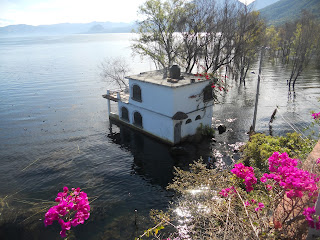
This left me and 'Cis to have long conversations about his Mayan heritage, the culture of Lago Atitlan, the poetry he enjoyed reading, and what he thought of the United States which were fascinating. The climb was beautiful and at the top (view seen above) we munched egg and roasted veggie sandwiches, basking in the sun, and semi-napping. No bandits to be found and in reality we didn't even need a guide as the trail was clearly marked and tourist police were posted a various points in the climb. 'Cis invited us back to his family's home in San Pedro where they treated us to hot chocolate that had been wrapped in orange leaves. His home very much reminded me of my childhood home in Mexico City with the corrugated aluminum roof and hand plastered concrete walls. 

We said farewell to the incessantly talkative Canadian heading off to our hotel in San Pedro, Mikaso. This was probably one of the more expensive hotels we stayed at (amounting to I believe 700 quetzales that night plus breakfast for 2 people), but at the same time seemed worth it precisely because we were exhausted by the climb and needed a good hard rest and a clean shower. After a shower we wandered around San Pedro getting a mediocre meal at some expat bar with the word "Buddha" somewhere in the name (clearly expats from  1990s America). After wandering San Pedro proper looking for a cash machine observing the market, the church, and the basket ball court (the 1954 occupation of Guatemala by the United States fostered this one cultural export) we returned to the shore area (colonized by ex-patriots from Norway, the United States, Germany, Britain, and of course, as with any space of natural beauty in Latin America, Spanish hippies) to have amazing drinks (blended pineapple with cardamon and rum, and some sort of green and fresh ginger + another alcohol) at this little possibly Canadian-expat and his Chapin (what Guatemalan's colloquially call themselves) boyfriend's restaurante called La Ventana Azul, a place I hands down recommend if you ever go to Lago Atitlan. 

Peaceful sleep and chill morning later J and I returned to Panajachel, the transit center of the lake, to catch a shuttle to Monterrico on the Pacific Coast. Here began the the trip's slump. I had insisted that we see the black, volcanic sand beaches of Guatemala, J wanted some beach time, and I thought it would be good to hit a space of Guatemala sans-tourists (it seems that often Mexicans and Central Americans spend time on the beach during the Christmas and New Years holiday). One onerous stupidity in my planning is for some reason I had thought that the travel to Monterrico would be an hour from Atitlan. This I discovered was not the case and shuttle took about 3 1/2 hours to get to the destination, on a fairly poor stretch of highway along the Pacific where the only traffic control mechanism were endless, unevenly built topes (speed bumps). We arrived to our expat owned hotel, this time a Norwegian man, with a much younger Guatemalan wife, and rushed to the beach for the last few hours of sun before the New Years' Eve festivities began. The beach and sunset to be sure were beautiful were it not for a mess of Middle Class Guatemalan's shit-talking us from afar, I wasn't clear on why. 

Rocky evening continued as we scoured the town for somewhere to eat, passing cholos in low riders, and families finally deciding on an expensive non-buffet-style buffet where we were not allowed to grab extra-beans despite not consuming any of the meats they offered. After a few drinks and the crawling experience of mosquitos chomping away at our bodies, coming off of the mangrove swamp the surround the beach, we parked ourselves closer to the ocean watching the stars come out. As midnight approached we retreated to a bar for a bucket of beers and watched the NYE pyrotechnics as it seemed every beach town on the Pacific Coast was lighting up their own vernacular fireworks display which was amazing in a way no orchestrated 4th of July fireworks show seems to achieve in the United States. This may have been the highlight of the visit to Monterrico. 

The next day we meandered around looking for a good beach spot and I realized the fundamental issue that emerges when you seek to avoid tourists altogether and you yourself are a tourist: people constantly give you looks the communicate "what the fuck are you doing here?" That coupled with the fact that J is rather muscular, large, Anglo in hair and eye color with a military style cut he probably looked like some Special Operations Forces trainer or at the very least a semi-imperialist gringo in look generated a significant amount of attention for J as we cruised around buying waters and snacks, something he found a little unnerving. We did find a nice relatively empty scrap of beach and watched Guatemalans sort of lay in the shallows like beached whales (culturally out hotel owner reminded us, it is not common for Guatemalan parents to teach their children to swim. One semi-irritating element that plagued us throughout the visit was the ladino families' enjoyment of endlessly driving all-terrain vehicles and dirt bikes up and down the beach. 

Later in the day after looking for another meal and releasing some baby sea turtles from a nearby sea turtle sanctuary (what Monterrico is famous for really) we settled back at the hotel, already we could tell that 1 day was just about enough to take in Monterrico, and laid around under the mosquito net on our bed looking through our photos, when J realized that he was having sort of reaction to the hotel food: shitting his brains out as well as vomiting. The hotel which surrounded a modest pool filled with screaming children, with loudspeakers blasting salsa, and neighbors in the adjoining room having very loud sex amounted to J's nightmare evening. I medicated J to get his fever down, asked the hotel owner to turn down the music, and we managed to get some sleep eagerly awaiting the shuttle that would take us off to Antigua for J's last day in Guatemala. After breakfast I promptly shat my pants and had to quickly shower so that we might make our shuttle on time and get out of Monterrico. I should say to tourists that Monterrico is much more of a place for families and not really one of the more important places to visit in Guatemala.

Antigua, a more standard tourist destination, was only a few hours away by shuttle and the cooler mountain air helped us shake off the unnerving elements of our visit to Monterrico. It is  colonial city, the former capital of Guatemala until earthquake wrecked significant components of the city's infrastructure, producing some really gorgeous ruins of former convents, monasteries, and a cathedral. In contrast to the humid, dub-step-drenched, bustle of Monterrico, Antigua Guatemala was a more peaceful hum of tourists, locals, and minor traffic on cobblestones. When compared to the life of the average Guatemalan Antigua appears to be a sort of middle class refuge in the mountains, which clearly has advantages of being fairly clean, I suppose it's safe (?), a few "apparent" 'mos walking around, but it also has the drawback of sheltering its residents (who are mostly ladino, i.e. mixed indigenous and Spanish/European) from the increasingly impoverished conditions of most of Guatemala that is at least 50% indigenous Maya (I've heard tell that the residents of Antigua work in Guatemala City and live in Antigua). We managed to see the most significant landmarks of Antigua on foot in about 8 hours, get some coffee, and have a really pleasant, altogether inauthentic, meal of paninis and Chilean wine in a garden restaurant that lost power halfway through our dinner. 


Early the next morning J had to shuttle it to the Guatemala City airport in order to return to work. I had the advantage of hanging out in Antigua that morning perusing the market there, having some excellent coffee (most Guatemalan coffee is harvested for export, not much roasting goes on in the country) and finishing Asturias' El SeƱor Presidente. My friend, B, had e-mailed me earlier that she would return to Guatemala city early that day and I should meet her at her home in Zone 2. I caught another camioneta back to Guatemala city and then a cab through to B's apartment. B's apartment was a typical Latin American construction with a great deal of internal windows to seal off or to better circulate air. I was still feeling physically ill so we didn't do anything particularly challenging: we checked out the anthropological museum I had missed my first time around, ate vegetable lo mein and fried rice at one of Guatemala city's numerous Chinese restaurants, hit a Guatemalan thrift store (where all the thrift store clothes that don't sell in the United States go), bought a few books in Spanish on the subject of my dissertation, chatted a great deal, and watched the entire first season of Game of Thrones. Along our walks I got to check out the graffiti and public postering projects of HIJOS Guatemala a public memory project to address the coerced amnesia about the civil war, the disappearances that remain unsolved, and to some degree to maintain the legacy of militancy and revolutionary spirit of the demilitarized, destroyed guerrilla organizations. Here is one example that is upside down because I can't figure out how to rotate images on this blog (translates roughly as "Military Service, Cerebral/Mental Death"):


It was actually very cool to hang out in the city with B, it remapped the space for me and B's ease of moving throughout the central zones (no longer sexually harassed because she was with a man) made it a pleasure even if my guts did not agree. Visiting Guatemala was an amazing way to get a better sense of the cultural texture of some of the region even if I spend a significant amount of time in tourist destinations. At the very least my Spanish was very good toward the end. I think another trip is in order in the future to get a better handle on peoples, politics, and the organization of the society now that another military leader is in power.

Wednesday, February 29, 2012

Guatemala, Guatebuena, Guatemaya 1

(Title stolen from an article by Edelberto Torres-Rivas you can find here.)


I've been meaning to post some details of my 10 day trip to Guatemala here, but the increasing stress from dissertation elements and long distance relationship, coupled with a sense that blogs are decreasingly useful mediums for communicating has delayed me significantly. 


Guatemala is a beautiful country with a systematically violent but also profoundly, richly political history. It is, by way of military, solidarity, and refugee discourses, a place think about somewhat in my dissertation. The motivations for going were therefore mixed. My boyfriend gets paid vacation time every year and he wanted a jaunt somewhere to help me at least "inhabit" the subject of my dissertation somewhat, even if that means I would be there having drinks and chilling by a giant, beautiful lake while reading about genocide. My friend B is also in Guatemala City (the capital) doing fieldwork for her anthropology PhD, so we had a potential person with who we could visit.


Because my bf doesn't have any free time in his job that demands he work 12 hour days, I did much of the planning on my own, consulting travel guides, friends, and also various internet review sites. Roughly sketched out the trip involved flying into Guatemala City, heading immediately out to Tikal, coming back to Guatemala City and shooting West toward Lago Atitlan for several days, hitting the Pacific Coast by way of Monterrico, spending a day and night in Antigua, back to Guate to see B. All compacted unrealistically into very little time.


Arrival in Guatemala City:


Pittsburgh is freezing during the Winter and it is also bleak, so banking off of clouds to see an overwhelmingly green landscape and warmth was a rather welcome sight. I had basically left us six hours to check out Anthropological Museums and eat in Guatemala City before catching a late night bus (on Linea Dorada) to Tikal. My plan was to get to a museum, stash our bags at the coat check, immerse ourselves in the anthropological material of the museum and then plan our next move, to hit a coffee or dinner, check el centro. We arrived the day after Christmas and I hadn't realized that the museums would be closed for a week for the holiday. We asked our cab driver to take us to another museum, which was also closed. Since we were near the center of town anyway we had him drop us off there so we could at least wander around and get some coffee or street food. I was at this point a little overtaken by panic, I foolishly internalize things like Guatemala's 200,000 genocide and the torture of thousands more as some sign that we too would be targeted and murdered, as obvious tourists. As irrational as I knew these feelings were, I couldn't quite keep my fear under control for the first hour or so in the city. 


We managed to find a decent coffee shop and we wandered around the plaza which was lovely, strung with lights, vendors selling elotes, etc., a cathedral with a few minor nondescript monuments to the genocide, and well kept flowers. Avenida 6a running down from the center of the plaza has been closed off to automobile traffic producing a very pleasant pedestrian avenue where we familiarized ourselves with the various iterations of the faux hawk popular amongst the nations young men. We managed to find a vegetarian restaurant at the end of the avenue where we munched on odd, but not altogether bad veggie variations of guatemalan traditional foods like tamales (in this nation wrapped in banana leaves rather than corn husks, as in Mexico). We split some overpriced beers and caught our overnight bus. (Incidentally Guatemalan beers aren't very good, as with other Latin American nations lagers are the preferred form, but the Gallos and Mozas were not particularly tasty.)


The bus was packed and the bus ticketing agent giggled at my gigantic internet print out tickets. Linea Dorada operates what seems comparable to Greyhound buses in the United States with semi-reclining seats and powerful aire acondicionado. I managed to not sleep very well and the bf snuck our arms around each other beneath our blanket (note to the homos: Guatemala is not a tolerant nation for homosexual peoples, it's best to travel on the DL if you can, although it is much more common for heterosexual men to touch other men and put their arms around friends or loved ones in public more than in the United States).


Tikal:


In order to visit Tikal National Park, an archeological treasure of an ancient Mayan city sitting at the edge of the jungle, you first fly or bus into Flores, a small island town where you either obtain a bus to the site or enjoin a tour company to get you to the site and guide you through was is a very confusing set of paths where tourists lose their way annually. After working on some miscommunication with our tour company we managed to get a bus over to the site, and checked around for guides who spoke English, so that my boyfriend (J from here on out) could also understand the tour. The tour lasted three hours and the site was beautiful, massive and impressive temples rising out of the jungle, ancient Maya stelae, and the odor of copal (a pine sap incense) which seemed to permeate much of Guatemala or at least infected my senses for the duration of the trip.


For the remaining evening hours in Flores, J and I snuck into an alley to throw on swim trunks and we hit the lake surrounding Flores during at sunset. The lake is pleasantly cool, but warm enough that one could spend some time there. Our dinner was fine, a little overpriced and not as good as breakfast. My favorite meal in Guatemala tended to be breakfast tipico, which consists of two eggs, black beans, toast, chirmol (a non-spicy tomato onion sauce), and fried plantains. This breakfast is to be found everywhere in Guatemala for cheap in even the smallest comedores. 


Toward Lago Atitlan:


We caught another overnight bus back to Guatemala City that night, arriving a half hour shy of 6am. Our guidebooks were fairly old, 2007 I believe was the most recent one we had between us, and we had plans to catch a camioneta to Panajachel, a city along Lago Atitlan, that morning from a particular site in Zone 1 Guatemala City. Our cab driver suggested that our books were wrong and the camionetas (or "chicken buses" as they are called by Anglos) picked up somewhere in Zone 8. Again I was confronted with a moment of First World panic (or maybe Mexican?--kidnapping is a national industry there) as I imagined another scenario in which we would again be robbed and murdered. We arrived and were told we need to catch a bus to a midpoint in Encuentros where we could catch a bus to Solola and onto Panajachel. Taking camionetas I think is a definitive experience for anyone visiting the country for the first time. These are former American school buses that are tricked out with bright colors, chrome plating, and have sound systems blasting reggeaton. Our driver looked like he was 19, his assistant 14, as they throttled up mountains at 90 mphs. 


As we travelled through the rainy landscape we were treated to another Guatemala's surprising features: a wandering evangelical Protestant Preacher. For the course of an hour we were force fed a stream-of-consciousness sermon about finding Jesus amidst family tragedy and several songs. One feature of the counterinsurgency wars in Central America has been the increasing presence and power of evangelical Christianity both as a corrective to Vatican 2s enabling of liberation theology (a significant element of revolutions in Guatemala and El Salvador) and to defuse political energies elsewhere than resistance to the mandates of the landed oligarchy and the army. After switching buses twice at a fairly efficient rate (both buses were waiting to pick up passengers and almost immediately left after we boarded) we arrived at a sunbaked Panajachel. After getting our bearings, consuming coffee and breakfast, we loaded onto a lancha headed for a hotel I had arranged for us in the small village of Jaibalito. Lanchas are the cheapest way to get around the lake towns as the lake is surrounded by forested volcanos. Typically you load onto a lancha with 15-20 other passangers making stops at villages and towns along the way. Atitlan has to be one of the most beautiful natural locations I have ever been so riding in the lancha was a rather amazing way to see the bright blue of the lake and the life surrounding the water.


Set in a beautifully manicured garden the hotel (called Vulcano Lodge) was a set of bungalows a bit off from the lake, and as soon as we arrived was the first time we had significant time to relax since the trip began. J and I snuck over to a neighboring hotel's patio/dock and spent the afternoon basking the beautiful surroundings, swimming, and reading, my recommended book of the trip El Presidente by Guatemalan novelist Miguel Angel-Asturias (which depicts the abjection and experience of living in the surveillance culture of a military dictatorship). As relaxing and restorative as the time at the lake was the way our hotel was set amidst a rather impoverished looking village with little in terms of public plumbing and not apparent school or medical services within reach (perhaps there is a hospital nearby)? It was a good reminder of the deeply inequitable and exploitative economic situation upon which the tourist economy sits in Guatemala (and also the degree to which the United States has been responsible for destroying its conduits for unrest about the inequality, as in overthrowing the first president to enforce a land reform). 


The hotel offered a family-style meal with other residents and seeing no other options for eating dinner we joined what appeared to be several incredibly boring MidWestern American and their Canadian equivalents for dinner. The food was relatively good, even for two vegetarians, and with the dull families we agreed to share a shuttle the next day to visit Chichicastenago, a mountain town famous for it's large markets vending "indigenous" textiles, pottery, and other goods as well as for a still very active syncretic Maya-Catholic culture. We arrived relatively early to Chichicastenago so the longer we paced the streets, the more narrow they became as vendors divided the streets with proliferating stalls. Many of the textiles, for which Guatemala is famous, were clearly made in factory contexts and not really the handicrafts one might expect, which is not surprising but it didn't stop the vendors from haggling with you complaining about the lack of value "mi trabajo" was receiving. We bought a few really nice pieces, but as the streets became more claustrophobic the process of haggling made me incredibly anxious; anxious because of an awareness of my position as someone coming from the core of the world economy and all the privileges it affords me arguing for a better price against someone with less prospects, in all probability a shorter lifespan, in a language I failed to maintain because it was easier to learn English than to try and maintain any semblance of my culture in the overwhelmingly homogenous MidWest of the US. More tension emerged later, J had suggested we try and find some decent street food which seemed in short supply in the streets we were exploring. On finding on stall we purchased some small tortillas and warm black beans, seeing not much else for vegetarians to consume. A potentially homeless man shoved himself next to us asking for money and a few tortillas, which spurred a fight between me and J over why I let said dude paw the food we had only just begun to eat. After a fight and a long session of lesbian-style processing we decided that despite the very cool tapestry we bought and getting a chance to see the interior of its Maya-Catholic church (reeking of copal incense) Chichi should have been a 3 hour trip, not one lasting the whole of a day.

Friday, October 28, 2011

2nd Accident, Hateful Insurance Companies

After being hit by a car earlier this summer I was still resolved to commute around Pittsburgh once the fog of the concussion lifted and I had the opportunity to adjust and build up a spare bicycle I had purchased from a friend a year before. 


Needless to say the accident before made me much more careful of how I conduct myself on the road, the risks I'm willing to take, and the attention I pay to others on the road. 


On one such careful commutes to school from my home I was sitting at a red light in a very busy intersection (actually approximately 2 blocks from the previous accident) and preparing to cross. This red light is particular because it is on a very busy road that is also between two university campuses. In order to allow pedestrians the ability to cross said road without having the potential threat of being struck by a turning vehicle the pedestrian walk sign lights up 10 seconds before the green light for vehicles headed in the same direction. 


At one such moment, sitting at the red light, I looked at each light in turn making sure all reds were illuminated as with the pedestrian light. I saw no vehicles in the intersection. I started pedaling into the intersection. I hear the roar of acceleration coming from my left turning just in time to see a red Suburban slamming into me and the tanned, chubby, blonde-hair ringed face of the driver staring down at me as she attempted to brake. She failed to run me over, and I looked up at her weepy face and yelled, "not another time this fucking year!" I limped to the corner dragging my bent (steel frame bicycle) behind me.


The driver parked and ran up to me weeping and shrieking to see if I was ok. Other drivers and bicyclists stopped and circled around checking on me, calling the police, and helping get the driver's insurance information. The Pittsburgh police did their usual bang up job by insisting that they were not going to write a report, nor were they going to issue the driver a citation for running the red light and hitting me. They were instead much more interested on whether or not the driver who was helping me was properly respecting their authority. (This is no shock as the Pittsburgh police are known to have a hefty history of violating resident's constitutional rights) 


The driver continued to hyperventilate and since I didn't detect immediately any broken bones and any real emergency, I was surprisingly lucky, I limped to my office to call the driver's insurance company and start the claim process. During the call I notice my left ankle swelling more and more, turning blue. The student health center determined that I had no significant bone breaking, mostly soft tissue damage, and eventually an injured tendon. 


Although I know I probably could have sued this woman's insurance company I didn't really have the time and emotional energy to get into a legal battle. So I gave the insurance company my statement expecting at least some sort of minimal recompense besides the medical costs associated with the accident. That was a semi-delusional attitude, as I later learned, moreover, NEVER GIVE AN INSURANCE COMPANY A STATEMENT IF YOU EXPECT THEM TO GIVE YOU A DECENT RECOMPENSE FOR THE SHIT YOU GO THROUGH, OR DESTROYED PROPERTY. First, speak with a lawyer, that is if you are certain you are not at fault. 


The insurance company gave me the run around offering me at the end around $500 for future medical costs, and for my destroyed bike because the frame was older. Little did they know or care was that the frame was a very sturdy 30 year-old frame which I had augmented with newer parts. I had to argue with them and suggested a much higher amount of a few thousand dollars. After hearing my objections they tacked on another couple of hundred dollars which frustrated me, and I started to object to which the agent, replied by insulting me. She insisted, "I know you got in another accident earlier this year and this makes me wonder..." Because I didn't want to hear the bullshit insurance company logic that dictated this incredibly soft-voiced, soprano midwestern woman I suggested that I would seek legal action and then hung up. I was in a rage for hours following that interaction, the notion that I would just liberally ride my bicycle in the way of cars only to wheedle money out of insurance companies had to be the largest deposit of feces I had ever been asked to ingest. Why the fuck, I thought, as a PhD student just recovered from a concussion would I ever risk my brain like that again? For a few hundred bucks? That is insane.


In the end I gave in. I have a prospectus to write, mounds of grading, and at the time a controversial argument to write for a panic inducing bilingual conference. I took the money so that I could eventually get a new bicycle and get on with my life and not endure anymore of the insults leveled at me by this woman, who for a second, almost got me to question my recollection of the collision itself. Fuck insurance companies. 


(Part 2, coming shortly, discusses the uselessness of university administrators in cases like these).

Thursday, September 15, 2011

Wednesday, July 20, 2011

How to Radicalize Graduate Students:

From Academe's July-August Issue:

Take these simple steps to intimidate, alienate, and agitate your own flock of graduate students.

By Heather Steffen

As the recession, budget cuts, endowment losses, and Republican governors gut university funding, campuses across the country have become host to occupations, union actions, and demonstrations.

Except for yours. When you gaze out on the quad, all that greets you is a file of book-bagged undergraduates nose deep in text messages, a few graduate students hauling books and lab equipment, and that weird squirrel with the crooked tail. What’s wrong with your corner of the ivory tower? Why aren’t your students marching shoulder to shoulder with the others? You included a three-week unit on Marxist criticism in your fall syllabus and proudly display your Obama ’08 poster, and last month you tacked a strip of Jorge Cham’s comic critique of academia over the photocopier, but your graduate students stubbornly look only to their reading, teaching, and the lab.

If this sounds like your campus, it’s time for a change. The steps below offer simple ways to rile up and radicalize your university’s graduate student population. Why target graduate students? Because they live and work at the crux of the university: when they’re not bothering you, these people are teaching undergraduates, giving conference papers, and living lives entwined with the community. Radicalize them and your university’s troubles will be broadcast where it counts—the classroom, the hotel bar, the statehouse. (And you can be assured, doctoral students will protest with abandon, having already demonstrated an underdeveloped sense of self-preservation by considering academic employment in the first place.)

But before we get to the steps you need to take, one caveat administrator: the things that radicalize are the same things that enervate. Your graduate students, appearances to the contrary, are intelligent adults with adult responsibilities and concerns. Those Chuck Taylor sneakers carry them home at the end of the day to support partners, care for children, feed pets, and call aging parents. Pressures and duties of that magnitude, on top of the commitments they’ve made to your university, are what make each turn of the screw worth two. But if you push too far, you’ll exhaust your most capable rabble-rousers and wind up with nothing but a bunch of broken-spirited, careerist brownnosers in your program.

On the upside, they’ll probably improve your program ranking, but walk this tightrope carefully. If you follow these six steps and keep a sharp eye out for signs of the tipping point between insurrection and burnout, your campus, too, can ring with the tones of disaffection, discontent, and incipient democracy.

Step 1. Build on graduate students’ existing strength: worrying. Depending on your region and Carnegie classification, you may be well on your way to creating a culture of anxiety, uncertainty, and self-doubt among your graduate students, and lord knows they arrive with plenty of that already on hand. But no matter how competitive and intimidating your campus is, the first step to fostering a vibrant radical population of graduate students is getting their hearts beating faster. These three tactics are sure to give any grad student’s pulse a jump-start:

A. Evaluation Assassination. When you evaluate a graduate student’s work, do you treat it like that of a future colleague, engaging with its ideas and style as if you were reading a friend’s article draft? If so, you’ll need to relearn your approach to grading. every seminar paper and dissertation chapter represents an opportunity to shake a graduate student to the very core. An offhand “This is not doctoral-level work” will more than suffice in most cases. (Nota bene: The probability of a demand for rationale decreases in inverse proportion to the time between submission and return of work.)

B. The Draft-and-Switch. Prospectus, research performance evaluation, thesis overview, dissertation: the merest whisper of any of these words makes graduate students curse having lapsed (“It was only one slice!”) on that irritable bowel syndrome diet. The draft-and-switch takes advantage of their inevitable prostration before the task of defining an academic identity. Advisers, perk up your ears.

A prospectus draft hits your inbox. Open that sucker up and give it a skim—does the lit review or the original research get more airtime? Whichever it is, fire off a response within hours apprising your student that she’s failed to incorporate the other. Include a list of at least six monographs against which the student has not adequately positioned herself, and request a total rewrite within three months.

Revision in hand, warm up your reply button, because you’re about to drop a bomb: the document must again be completely recast, and you are concerned about the project’s viability: “This reads like a review essay; what is your argument?” Before closing, recall to the student’s mind that her standing in the program depends upon swift approval by multiple entities and reveal that you are not at this juncture certain of her ability to meet the deadline. Will the student think she’s lost her mind? Will she spend the next two hours combing through her e-mail for your previous comments? Yes, all the while shaking like a leaf. Give yourself a pat on the back, open a celebratory diet coke, and wait for draft three.

C. The HPT Meeting. Around the Pentagon, HPT stands for “high-payoff target,” and that’s exactly what you’re aiming for, so use this tactic sparingly. Here, HPT is a mnemonic you can use to plan meetings with overconfident graduate students.

A few days after a friendly interaction (drinks at a reception, a chat in the hall about good news on the publishing front, or some similar light conversation), casually request a meeting with your student to check up on his progress. Be sure to say something personal in the e-mail to maximize the sense of informality (“I was glad to hear that your cat’s surgery was successful!”).

Meeting set, the HPT agenda proceeds as follows: (1) Humiliate the student immediately by asking an exam-style question tangential to his area of knowledge. After he stumbles through an answer, inform him that he is devastatingly wrong (for proper affect management, imagine he’s just farted audibly while speaking). As he tilts toward the abyss of his self- doubt, (2) patronizingly offer an olive branch to help him out—a task useful to your own research that also happens to be the only thing capable of saving him from his overwhelming wrongness. You’ll either get a domesticated free research assistant or he’ll resist, declaring that that is not what his project is about at all. If the latter occurs, (3) bring out the threats: “It will be very hard for your thesis to gain my approval if this is not accounted for.” As fear enters your student’s eyes, open the door, extend your best wishes to the cat, and tell him you’ll look forward to seeing how his work progresses. If you’re not naturally coldhearted, the HPT meeting might shake you up a little, but keep in mind that as you’re sipping your evening pinot, your student might be getting in touch with his inner Wobbly at the bar down the street.

Step 2. Practice nepotism and lack of transparency in policy and decision making. Experienced administrators will roll their eyes at this one: “I already do that. I wasn’t promoted because of my sterling teaching record, you know.” But for the sake of faculty readers new to the managerial rim of the labor divide (that’s you, Ohioans), a few words on nepotism and obfuscation are in order.

Nepotism in regard to graduate students is easy, and chances are you’re already better at it than you think. Have you ever invited a couple of friends to present on a panel because writing a call for proposals would take too long or given the nod to a mediocre job candidate whose thesis happens to be signed by your college roommate? Congratulations, you’re half-way there! Now just turn the same principles to the assignment of plum classes and jobs to your favorite graduate students.

When they start to notice the repetitions in the course catalog, it’s time to shut the window on your decision-making process. Remember that graduate students are heavily invested in meritocratic and democratic ideals, so if they see perks accruing where they aren’t deserved and program requirements becoming a moving target, they’re going to want to nose out the culprit. By keeping the decision-making process tightly under wraps, you’ll not only increase its efficiency but also help your graduate students hone their investigative research and networking skills while they close read the handbook and compare notes with their comrades in other departments. Suppression of information is the agar in the petri dish of revolt, after all.

Step 3. Raise tuition and fees. Graduate students don’t pay tuition, do they? But why not? Take a look at your department’s budget sheet—how many of your hard-earned FTEs are wasted reimbursing the university for graduate credit hours? No one’s even teaching those classes, what with the pack of dinosaur ABDs you’ve got hanging around. A refresher on accounting and some well-timed hints about counterbalancing the athletic director’s fall spending spree will not only unify students across the two cultures, it might even get your name on the CFO’s go-to list next time a spot opens up in administration. To preview the results you can get from this one simple tip, look no further than California and Illinois, where just the threat of tuition increase spurred months of strikes, insurgent dance parties, and the authoring of manifesto upon manifesto.

Step 4. Pay them below the living wage. Choosing to starve your students might sound distasteful, but if they’re getting PhDs in late-thirteenth-century barley farming or the morphology of south Bolivian musk gnats, they must come from well-to-do backgrounds, right? These pampered savants need a reason to identify with the working man, and there’s no better way to foster identification than to make sure they’re standing behind him in the Shop ’n Save checkout line instead of flipping through a Dwell at Whole Foods. It might make them less entertaining dinner companions, but the gains in class consciousness will more than compensate for any lack of fluency in microgreens and manchego.

Step 5. Cut centers, programs, and departments. Even—if you’re as daring as the Minnesotans were—dissolve the graduate school. For maximum impact, go for the arts and humanities first. Donors and corporate partners are unlikely to register the loss, and students on the softer side of campus are already steeped in leftist theory, jealous of their profs’ glory days in the sixties and convinced of the need to enlighten the masses, so they’ll take the dissolution particularly hard. (And when was the last time you saw video of stomatology students getting arrested for failure to disperse?)

Step 6. Keep that tenured head buried in the sand. Are flyers about a graduate student union showing up on the bulletin board across the hall? Did the administration just announce that graduate tuition and fees are going up? Who cares? You’ve already got fifty-two hours of research, peer reviewing, committee work, and lecturing to do every week, so going to bat for your grad students is the last thing on your to-do list, and you should let them know that—loud and clear. If a wild-eyed graduate student idealist asks you to talk to your faculty senate or to advocate for the union, blink confusedly, mumble something that intelligibly includes the word “busy,” and remember to keep your office lights dimmed next time you come in for a meeting. Knowing they’re on their own encourages graduate student self-reliance and solidarity with organizations that really can help them out.

Follow these six easy steps, and pretty soon your campus could join the lucky ones already garnering the attention of police and Fox news anchors. Then you can sit back and let your grad students and the exasperated public take it from there. As one effectively and efficiently radicalized student at the University at Albany put it last January, “A lot of people who are supposed to be protecting us aren’t doing that. So unless we turn a little wolfish on them, they’ll just eat the sheep
.”

Wednesday, June 29, 2011

A car collided with my bicycle and me


Everyone I know who commutes by bicycle long term has had some kind of accident. These accidents might be minor, as in breaking one's finger defending oneself against an opening car door, or, major, as in brain swelling resulting from a collision with a motorcycle. I myself avoided getting hit for my seven years until May 26th, hours before the birthday barbecue I had planned for myself.

I was pressured by my boss to attend a "grading-calibration" with other graduate instructors to discuss how best to mark papers and give appropriate feedback. After a pretty big fight with my boyfriend, I rode with an irritated and distracted mind. I flew down the hill toward the parking garage, entered the garage at an uphill angle, slowing me down significantly. I started making my way back to a point at which I would turn left and then head to my office. But my memory is blank but for the brief moment of the collision, where I see the driver's beige Mazda hit me from the side as I collide with the hood of the car, and then another blank space.

I came to sitting on the curb as a police officer attempted to gather information from me. The collision between my head the pavement had split my helmet, and the front fork of my bicycle was badly dented. I was walking and that was a good sign. Nonetheless an ambulance hustled me to the hospital; all the while making phone calls to see if previously-mentioned boyfriend could meet me at the hospital and alerting my boss that I wouldn't make it to the session. At that point I felt, not so much confused--I felt relatively lucid--but caught up in the ridiculousness of the scenario. I persisted in asking the doctors who stitched me up and the care-providers who cleaned off my wounds questions like, "Is it true that human mouths are ten times dirtier than dog mouths?" I think at that point the whole thing seemed so surreal for me.

After some tests and about twenty minutes of CAT scans it was confirmed that I had escaped with only three deep abrasions on my face and a minor concussion. The doctors decided that I should stay overnight so that they might monitor my concussion. Luckily, the trauma clinic room I inhabited for the night I shared with an older gentleman who had recently undergone surgery for his hernia. This man proceeded to spend all night watching Fox News loudly, tossing and turning in bed, complaining, and demanding room temperature ginger-ale for his ailing stomach. My boyfriend was terribly concerned and kept threatening to get the driver, a Chinese national, deported. But after washing off the blood and stank in my morning hospital shower I was free to go (incidentally, the hospital stay, x-rays, ambulance, etc. totally around $33,000 for those of you who want to argue that market mechanisms keep healthcare costs down).

Returning to find my bike I discovered the frame to be fucked (on consultation with a local shop) apparently it buckled from the collision. Because the frame is aluminum it is useless to repair as any hammering back into shape would produce a weaker frame. Moreover, the police report after much bureaucratic hassle indicates that there were no witnesses and the driver claiming he was driving 10 mph (downhill?!) and I on the other hand was going "quite fast." After discussing the matter with a lawyer he suggested that the case didn't look good precisely because it would be my speculations against the driver's word. This was rather disappointing to me precisely because I am now without my central means of transportation. Moreover, how could I have a concussion from colliding with someone driving 10 mphs? That has to be a lie!

More irritating, perhaps, is the fact that the concussion for about 2 weeks made it difficult to concentrate on anything for more than an hour seriously inhibiting my ability to work on my dissertation.

WEAR A DAMN HELMET! I don't give a fuck if it messes up your coiffure!

Tuesday, May 3, 2011

A Note For Those Who Advocate "English-Only" Policies

While putting together an encyclopedia entry on Latino struggle, I came across an observation from Rumbaut & Portes from their Ethnicities: Children of Immigrants in America anthology:

"Forceful assimilationism does not seek to expel newcomers but to integrate them as quickly as possible into the American mainstrean. English immersion and the rapid loss of languages and cultures promoted by assimilationist policies weaken immigrant parents' authority and help drive a wedge between generations [...] The paradox, is that, in seeking to make 'good Americans' out of the second generation, English immersion and similar programs undermine the single resource poor immigrant youths have to succeed: namely, the social capital inherent in their families and co-ethnic communities. In the programmatic scenario promoted by forceful assimilationism, schools and immigrant families work at cross-purposes, with negative consequences for both" (315).

This suggests the fundamentally maliciousness of English only policy that seeks to actually eliminate the possibility of upward mobility for immigrant communities and instead producing what the authors describe as a "rainbow underclass."

Monday, January 24, 2011

2004, Response to Rumsfeld

In reading Greg Grandin's excellent history of the 1980s proxy wars waged by President Ronald Reagan in Central America, entitled Empire's Workshop: Latin America, the United States, and the New Imperialism, Grandin notes an Ecuadorean general's response to Donald Rumsfeld's insistence that Latin America begin to "consolidate control" by way of the United States of potential terrorist, drug-trafficking, and guerilla threats,


"'In Latin America,' Vargas retorted, 'there are no terrorists--only hunger and unemployment and deliquents who turn to crime. What are we going to do, hit you with a banana?'"